
AI-Assisted RECIST CT Measurement Cut Reading Time
10/16/2026
Key Takeaways
- For remeasurement of predefined target lesions on follow-up CT, AI-assisted proposals reduced reading time by 33.6% versus unassisted interpretation; the authors note savings would likely be smaller in a complete RECIST 1.1 assessment that also includes nontarget and new lesions.
- AI assistance improved interreader agreement in patient-level RECIST outcome classification compared with unassisted reading.
- Against an expert-derived reference, lesion-level measurement deviation was higher with AI assistance than with unassisted reading.
- Expert-generated proposals were accepted more often and needed fewer substantial modifications than AI-generated proposals for both radiologists and residents.
Follow-up chest-abdomen-pelvis computed tomography examinations from 212 oncology patients at 2 Dutch hospitals formed a retrospective multireader, multicase crossover study of 539 RECIST target lesions across 277 computed tomography series pairs. Twenty-three physicians from 11 international institutions participated, including 15 radiologists and 8 residents. The Dutch setting is central to the dataset, although the workflow question is also recognizable in North American oncology imaging where RECIST-based follow-up measurement is used. None of the patients in the evaluation cohort had been used to train the AI model.
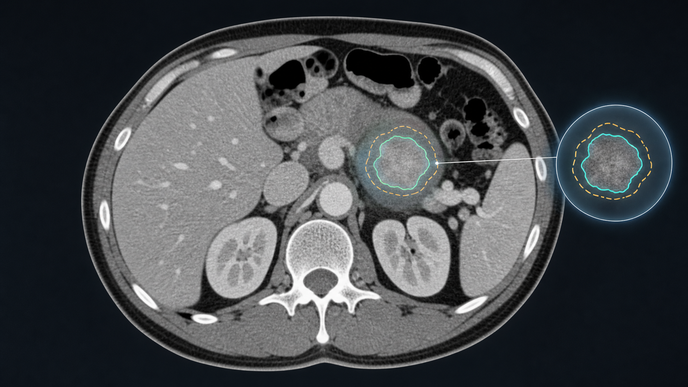
Paired baseline and follow-up scans were displayed with baseline target lesions already measured, and the AI system generated follow-up proposals by propagating lesion center points from baseline, aligning the scans with image registration, and segmenting lesions through a three-dimensional U-Net-based workflow. Human review remained central because readers could accept, modify, or replace each proposed measurement. Expert-assisted proposals came from prior unassisted radiologist measurements, and readers were told that all assistance was AI-derived to minimize expectation bias.
For efficiency, the patient-level RECIST agreement and reading-time results showed that AI assistance reduced per-patient reading time by 36.0 seconds versus unassisted reading (95% CI, -53.0 to -22.1), corresponding to a 33.6% reduction (95% CI, 22.5-43.0), although the authors noted that this estimate came from target-lesion remeasurement only and that savings would likely be smaller in a complete RECIST 1.1 assessment including nontarget and new lesions. Mean expected reading times per read were 105 seconds unassisted, 71 seconds with AI assistance, and 56 seconds with expert assistance; however, the authors noted that expert assistance requires an initial unassisted read, making the cumulative double-reading workflow 151 seconds.
Consistency results were more mixed. AI assistance increased patient-level RECIST outcome agreement by 7.7 percentage points versus unassisted reading (95% CI, 2.8-12.7), while expert-assisted reading increased agreement by 13.3 percentage points (95% CI, 8.6-18.1). At the lesion level, however, variability was higher with AI assistance relative to the expert-derived reference standard, increasing by 1.32 mm (95% CI, 0.83-1.91). Investigators did not see a meaningful difference in estimated tumor burden change between AI-assisted and unassisted reading.
Proposal handling clarified where the gap remained between automation support and prior human measurements. Expert-generated proposals were accepted more often and were less likely to need substantial modification, defined as a greater than 20% relative size change or a shift in measurability status. Across radiologists and residents, that pattern left AI support looking helpful for workflow and patient-level agreement, but not yet interchangeable with expert-generated starting points.
Lesion-level variability was judged against the mean of the expert-assisted radiologists, which biases that comparison toward the expert-assisted condition. Readers also worked in custom CIRRUS software rather than their usual picture archiving and communication system environments, baseline target lesions were predefined, and nontarget or new lesions were not part of the analysis, so the RECIST outcome assessment reflected target-lesion sum of longest diameters rather than a full RECIST 1.1 evaluation. Because different readers assessed a given patient under different conditions, some between-reader variation remained embedded in the crossover design.
AI assistance was framed as a reader-in-the-loop workflow that still requires oversight, especially when anatomy changes markedly or lesions disappear between scans. Next steps named in the paper included prospective validation in a different healthcare setting, integration into routine picture archiving and communication system workflows, evaluation of regulatory endpoints that include patient-level response agreement and failure modes, and exploration of volumetric tumor assessment. In that context, expert-assisted performance serves as a benchmark for further model refinement rather than proof that AI and expert proposals are equivalent.
Clinician Questions
How was AI-assisted RECIST measurement set up in follow-up body CT for patients with cancer?
AI-assisted RECIST measurement in follow-up chest-abdomen-pelvis computed tomography used paired baseline and follow-up scans with premeasured baseline target lesions already identified. The system propagated lesion center points from baseline to follow-up, applied image registration and a three-dimensional U-Net-based segmentation workflow to generate follow-up measurement proposals, and then let readers accept, modify, or replace each proposal.
Which parts of RECIST 1.1 did this AI reader study evaluate, and which parts did it leave out?
The reader study evaluated remeasurement of predefined target lesions on follow-up scans and patient-level change in the sum of longest diameters used for RECIST outcome agreement. Nontarget lesions and new lesions were not assessed, so the analysis did not represent a full guideline-compliant RECIST 1.1 evaluation.
Why were expert-assisted proposals still a stronger benchmark than AI-generated proposals in this RECIST workflow?
Expert-assisted proposals remained the stronger benchmark because both radiologists and residents accepted them more often and made fewer substantial modifications than they did with AI-generated proposals. Harder scenarios included major anatomic change and disappearing lesions, indicating that current AI proposals still required reader oversight in those settings.