
Roginolisib Trial Shows PI3Kδ Target Engagement in Uveal Melanoma
10/13/2026
Key Takeaways
- Among patients with advanced solid or hematologic malignancies receiving daily roginolisib, no dose-limiting toxicities occurred, and severe drug-related events were less common than severe events from all causes.
- Basophil testing and drug exposure supported sustained PI3Kδ target engagement at the selected daily dose.
- Metastatic uveal melanoma survival estimates were reported at December 2023 and February 2026 cutoffs without a concurrent comparator.
- In a post hoc association, observed survival was longer with stable disease than with progression at week 16.
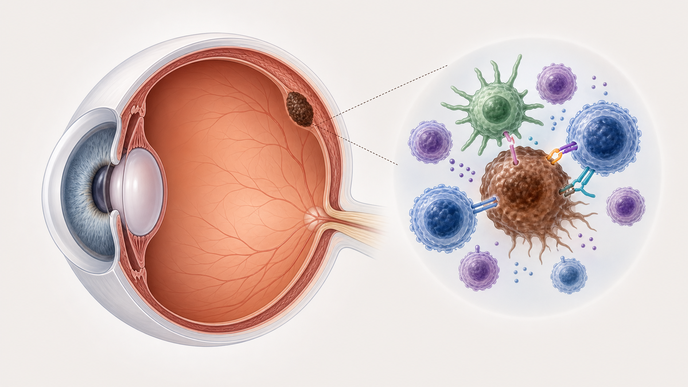
- Exploratory assays showed fewer regulatory T cells alongside increases in CD8+CD39+ T cells and soluble IL-15.
Investigators conducted the first-in-human roginolisib trial in Nature Communications as a nonrandomized, once-daily oral study (NCT04328844). Eligible patients had progressed on their last standard therapy or had a contraindication to approved therapy. Of 44 participants, 24 entered Part A dose escalation across solid tumors and follicular lymphoma, and 20 entered the Part B mUM expansion. Nearly all patients with mUM had received prior systemic therapy. Across both parts, 29 had mUM; 27 were efficacy evaluable. Safety was primary; pharmacokinetics (PK), pharmacodynamics (PD) and radiographic tumor measures were secondary. Imaging under Response Evaluation Criteria in Solid Tumors (RECIST) version 1.1 occurred every two cycles. The basophil activation test (BAT) measured PI3Kδ-linked CD63 activity; immune and plasma assays were exploratory. Updated PK/PD modeling, exposure and BAT inhibition informed dose selection rather than a maximum-tolerated dose.
No dose-limiting toxicity was recorded, and no maximum-tolerated dose was declared. Grade 3 or higher drug-related treatment-emergent adverse events (TEAEs) occurred in 3/44 (6.8%), compared with 14/44 (31.8%) all-cause events at that severity. Treatment-related decreases in platelets and neutrophils and an increase in lipase were transient. Grade 2 drug-related diarrhea prompted one dose reduction from 80 to 60 mg. One patient with mUM stopped treatment after grade 2 uveitis early in treatment; similar symptoms had occurred during prior pembrolizumab use. Exposure rose approximately with dose. At 80 mg once daily, BAT CD63 inhibition plateaued, and steady-state trough exposure supported the investigators’ designation of a biologically effective, recommended phase 2 dose and their conclusion of sustained PI3Kδ inhibition greater than 90%.
For mUM across both study parts, the authors report median overall survival (OS) of 20.8 months (95% confidence interval [CI], 10.7–29.5) at a stated December 2023 cutoff, although the paper also describes enrollment continuing through December 2024. They report median OS of 18.4 months (95% CI, 9.66–29.47) at the February 2026 cutoff. In a post hoc comparison of groups defined after treatment began, median OS was 28.5 months with stable disease at week 16 versus 12.3 months with progression—an exploratory association, not a treatment contrast. Among 27 efficacy-evaluable patients with mUM, one had a partial response (3.7%); median progression-free survival was 5.3 months (95% CI, 3.7–5.9). In separate available-sample subsets, blood mass cytometry showed declining regulatory T-cell abundance and rising CD8+CD39+ T-cell frequency; the latter was positively correlated with OS during follow-up. Plasma assays showed increased soluble interleukin-15 (IL-15).
Without a concurrent comparator, survival observations cannot establish a roginolisib survival effect. Part A included different malignancies, and mUM outcomes across both parts should not be confused with outcomes in the expansion cohort alone. Week-16 groups were defined after treatment began; five efficacy-evaluable patients lacked an assessable scan, and upper confidence limits for stratum-specific survival medians were not estimable. Small, differently sampled translational subsets cannot establish predictive biomarkers.
The authors reported tolerability, pharmacologically supported target engagement and exploratory clinical and immune signals during daily roginolisib treatment. Single-arm survival observations and biomarker associations do not establish comparative benefit or validated prediction.
Clinician Questions
How did patient-reported fatigue and pain change during daily roginolisib treatment for metastatic uveal melanoma?
Among expansion participants who returned symptom questionnaires, investigators found no overall worsening in diarrhea, abdominal pain or general pain during treatment. Fatigue, abdominal pain and pain interference improved in most assessed respondents by week 16; later symptom worsening coincided with disease progression. These exploratory findings reflect respondents rather than the entire expansion cohort.
Why was basophil CD63 used to assess roginolisib target engagement in advanced cancer?
Investigators used basophil activation and its CD63 response as a functional readout of PI3Kδ signaling instead of measuring phosphorylated AKT in circulating blood or tumor cells. The assay permitted assessment across participating sites, but CD63 was not established as a predictor of survival.