
Urine Methylation Assay Detects Urothelial Cancer Recurrence
10/16/2026
Key Takeaways
- Among adults evaluated for urothelial carcinoma at three tertiary centers in China, a urine methylation assay showed high sensitivity and specificity in multicenter validation.
- The assay also detected Ta and low-grade tumors, although sensitivity was lower than for urothelial carcinoma overall.
- In smaller directly tested groups, the assay was more sensitive than cytology and fluorescence in situ hybridization, with similar or higher specificity.
- During short postoperative follow-up, the assay detected all 9 clinically observed recurrences, with a median 4.5-month lead time before clinical confirmation; some positive results had no confirmed recurrence.
A prospective, blinded diagnostic study enrolled adults at three tertiary centers in China, with 643 in an assay-training cohort and 1620 in a preoperative multicenter validation cohort. A separate cohort contributed longitudinal postoperative urine samples. Participants included patients with pathologically confirmed primary or recurrent bladder or upper-tract UC, benign urinary disease, or untreated nonurothelial malignancies. Histopathology of endoscopically obtained material was the diagnostic reference, and laboratory personnel and pathologists were blinded to relevant findings. Postoperative patients underwent routine cystoscopy and/or imaging; urine assay results remained hidden from treating clinicians and did not alter surveillance schedules.
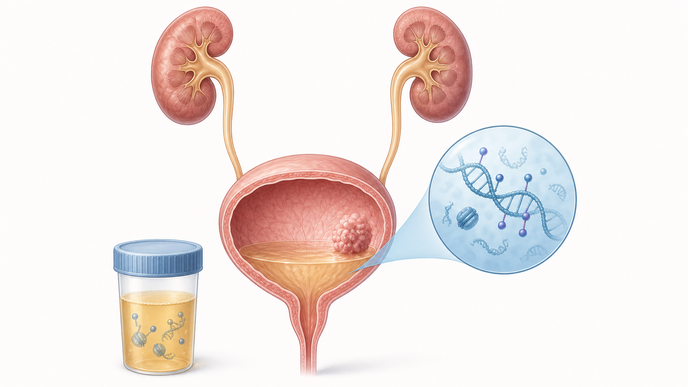
The IUrisure assay uses DNA extracted from 1 mL of whole urine, followed by bisulfite conversion and quantitative methylation-specific polymerase chain reaction (PCR) targeting AL021918.2 and VIM. A sample is positive if either target is methylation-positive. Thresholds were established in the training cohort, and a beta-actin (ACTB) internal control determined whether results were valid. Testing showed reproducibility across batches, operators, and days. Urine cytology and fluorescence in situ hybridization (FISH) were compared directly with the assay in smaller tested groups, not across the entire validation cohort. Postoperative urine was collected approximately every three months.
Multicenter validation yielded 90.8% sensitivity and 93.2% specificity for UC. The training cohort also showed high sensitivity and specificity, but its results helped establish assay thresholds rather than replacing the prospective validation estimates. These figures measure diagnostic discrimination against the enrolled comparison groups; they do not measure what happens when a urine result directs postoperative care.
Validation sensitivity for Ta and low-grade tumors was lower than the overall UC estimate, although both groups were detected. In direct comparisons involving bladder and upper-tract disease, the assay was more sensitive than cytology or FISH, with similar or higher specificity. Those findings came from smaller groups receiving the relevant comparator tests and do not establish superiority over methylation assays described in other investigations.
Postoperative surveillance addressed a different endpoint: the assay identified all 9 clinically observed recurrences, first becoming positive a median 4.5 months before clinical confirmation. This lead time describes when the signal appeared relative to the clinical finding. It does not establish that acting on an earlier result changes detection, treatment, or patient outcomes.
Among surveillance patients without clinically confirmed recurrence, 29 of 35 remained assay-negative during observation. Most patients with paired positive preoperative results became assay-negative after surgery, providing a separate within-person observation. A postoperative positive result without confirmed recurrence was not counted as a future cancer event.
The postoperative cohort comprised 44 patients and had a median follow-up of 6 months. Some positive urine results, including repeated positives, were not accompanied by clinically confirmed recurrence during available follow-up. Clinicians did not use the assay to change surveillance, and no randomized comparison tested assay-assisted monitoring against standard cystoscopic surveillance. The blinded diagnostic accuracy results therefore do not establish that urine-guided monitoring improves outcomes or replaces cystoscopy.
The investigators describe AL021918.2/VIM methylation as a potential adjunct for UC diagnosis and postoperative monitoring. They propose larger longitudinal surveillance work and a randomized comparison of assay-assisted with standard cystoscopic surveillance to determine whether changing care in response to urine results improves outcomes.
Clinician Questions
Can a positive AL021918.2/VIM urine assay distinguish urothelial carcinoma from other urinary cancers?
Adults with benign urinary disorders and nonurothelial urinary malignancies were included in the evaluation. Specificity was lower among those with other urinary malignancies, primarily kidney and prostate cancers, than among those with benign disease. A positive methylation result alone did not establish the cancer type; the investigators described interpreting it against the broader clinical profile.
How was postoperative urothelial carcinoma recurrence determined when monitoring AL021918.2/VIM urine methylation?
Recurrence was ascertained through a composite of clinical and pathologic diagnoses while patients underwent routine cystoscopy and/or imaging. The urine assay alone was not the reference for recurrence, and its results were withheld from treating clinicians.