
Transcript
Announcer:
You’re listening to Project Oncology on ReachMD, and this episode is sponsored by Boehringer Ingelheim Pharmaceuticals, Inc. Here’s your host, Dr. Charles Turck.
Dr. Turck:
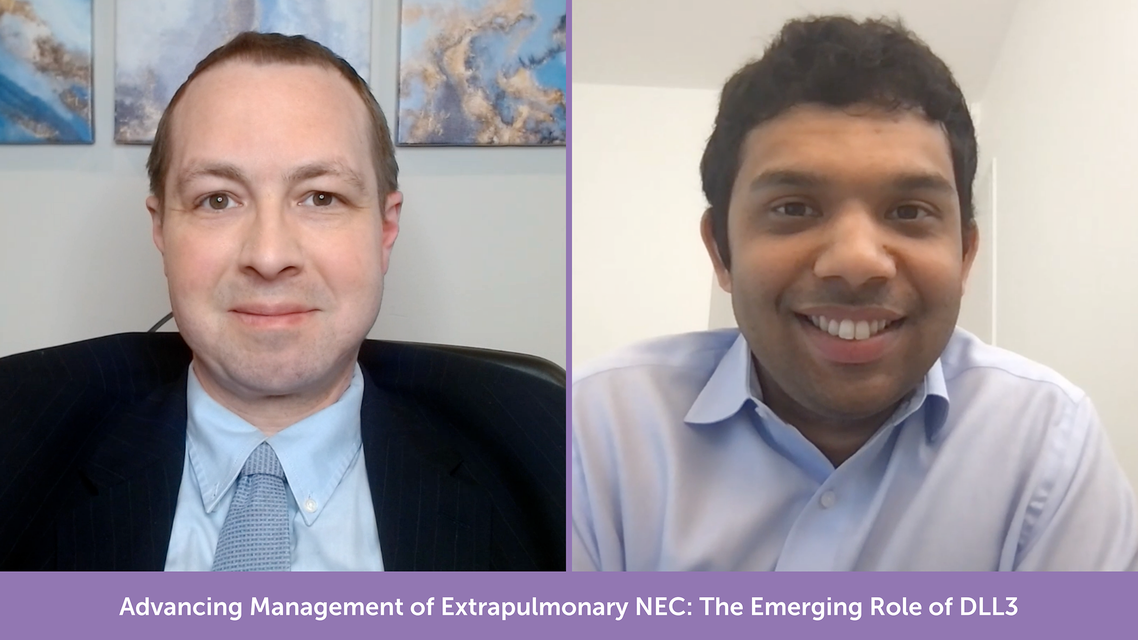
This is Project Oncology on ReachMD, and I'm Dr. Charles Turck. Joining me to discuss the evolving role of DLL3 in extrapulmonary neuroendocrine carcinoma, or NEC for short, is Dr. Rohit Thummalapalli. He's a gastrointestinal medical oncologist at Memorial Sloan Kettering Cancer Center in New York.
Dr. Thummalapalli, welcome to the program.
Dr. Thummalapalli:
Thank you so much for having me. I'm excited to talk today.
Dr. Turck:
Well, let's begin with some context, Dr. Thummalapalli. Beyond the fact that DLL3 is often overexpressed in high-grade neuroendocrine neoplasms, what is it about its expression pattern and biology that has made it such a compelling and actionable target?
Dr. Thummalapalli:
I think DLL3 is one of the most exciting targets we have right now in neuroendocrine cancers. We already have a positive phase 3 trial in small cell lung cancer for tarlatamab, a DLL3-targeted bispecific T-cell engager. We have multiple clinical trials across therapeutic classes in both pulmonary and extrapulmonary NEC that are looking at a number of DLL3-targeted therapies.
One of the reasons that DLL3 has been a very compelling drug candidate is because of its relatively low expression on normal tissues. So, when we think about targeting cell surface antigen and solid tumor oncology, we are often limited therapeutic index-wise by the amount of expression of that target on healthy tissues along the liver, the bone marrow, and so on and so forth. What has been fortunate about DLL3 is that the amount of cell surface expression of DLL3 has been found to be low in a majority of healthy organs in the body.
And what has also been an interesting observation is that neuroendocrine cancer cells seem to preferentially express DLL3 on the cell-surface, whereas normal healthy tissues seem to preferentially express DLL3 in the cytoplasm, which makes it a compelling drug target, at least in theory.
Dr. Turck:
Now, what initially made investigators cautious about whether DLL3 expression in biology would translate clinically?
Dr. Thummalapalli:
I think what probably made the entire field cautiously optimistic—emphasis on caution—is how difficult these cancers have been to treat historically. When we're talking about small cell lung cancer, other pulmonary neuroendocrine cancers, or extrapulmonary neuroendocrine cancers, for decades, the standard of care has been various iterations of platinum-based chemotherapy, and we really have not had targeted therapies tailored to specific biomarkers in patient tumors to help dictate care. The paradigm of a targeted therapy in neuroendocrine cancer has not been established for many years.
There certainly have been questions about, for example, how clonal is DLL3? Is it expressed in all the tumor cells? Even if we see frequent expression, is there sufficient expression to lead to response to DLL3-targeted therapy? Are there tumor sub clones that don't express the target, that are not going to respond, and that are limited in effectiveness? These are all questions that we have worked with and worked around for the last five plus years.
Dr. Turck:
Now, when we focus specifically on extrapulmonary NEC, where is the DLL3 evidence most consistent across tumor types and clinical contexts, and where do we see meaningful gaps, maybe across different primary sites, biopsy types, or lines of therapy?
Dr. Thummalapalli:
This data is really emerging, and it's a work in progress. I think up until even two years ago, our understanding of DLL3 being expressed frequently in extrapulmonary NEC was very limited. We have now had multiple at least retrospective studies that have shown that in many subsets of extrapulmonary NECs, including GI, GU, and GYN, for example, we do see recurrent DLL3 expression in somewhere around 60 to 80 percent of tumors.
There are limitations in these analyses; they're retrospective analyses that can be subject to biases in terms of the types of patients that are included, the quality of tissue, and the cutoffs for the DLL3 expression that help define something that's positive. There are a lot of different variables that go into that estimation of how frequently these tumors are positive. But we are seeing more evidence across multiple studies that more than half, maybe even about three quarters, of patients with gastrointestinal, genitourinary, and GYN neuroendocrine carcinomas likely do express DLL3.
Dr. Turck:
For those just tuning in, you're listening to Project Oncology on ReachMD. I'm Dr. Charles Turck, and I'm speaking with Dr. Rohit Thummalapalli about DLL3 biology in extrapulmonary neuroendocrine carcinoma and what it may mean for clinical practice.
So, Dr. Thummalapalli, now that we have some background on DLL3, how should we be thinking about the role of DLL3 testing in extrapulmonary NEC today?
Dr. Thummalapalli:
We do have a number of studies that are investigating DLL3 targeted therapy specifically of this population. These include T-cell engagers and antibody-drug conjugates for now, and there are a number of up-and-coming therapies, including radioligand therapies and CAR T-cell therapies, that are also being investigated in the coming few years.
To date, one of the strongest pieces of data that we have so far in the space comes from obrixtamig, a DLL3 T-cell engager for which we have phase 1 and 1B data that have been presented over the past year, showing a promising response rate and durability of response for patients treated with extrapulmonary NEC in the chemo-refractory setting with this obrixtamig.
And what we have shown, which was presented last year by Jaume Capdevila at ASCO 2025, appears to be, at least from early data, is that response to DLL3 T-cell engagement therapy, obrixtamig, appears to be tightly linked to the amount of DLL3 expression on tumor cells. For obrixtamig, it appears to be that 50 percent or higher DLL3 expression appears to be associated with better outcomes with this drug. And so this is going to be prospectively investigated in an ongoing phase 2 trial looking at the activity of obrixtamig, specifically in extrapulmonary NEC with DLL3-high expression defined as 50 percent or higher.
But there are a number of other T-cell engagers, antibody-drug conjugates, and other agents in this space that I think also certainly have promise to help patients with this diagnosis, for which we do not yet know the cutoffs for DLL3 expression. And we also don't know if there are other biomarkers that might be more helpful as well.
I think one thing to be mentioned is that right now, one of the main biomarkers we have that we're testing for is DLL3 immunohistochemistry, or IHC, looking for protein in a tumor biopsy. There are limitations with that too, because we often think about using old tumor biopsies prior to chemotherapy exposure, which may or may not reflect what's happening in the patient at the moment.
It's also possible that different sites of the disease—whether a liver metastasis versus a primary tumor versus a lung metastasis, for example—that they could have heterogeneous DLL3 expression levels, and having one biopsy from one tumor may be limited in capturing that heterogeneity. I think there are still a lot of questions about what the perfect biomarker is going to be, and I think it's probably going to be different for different types of DLL3 targeted therapies. But the summary is right now, the most common biomarker we'd use is IHC from an archival or fresh tumor sample.
And I do think it is important for oncologists, both in academic and community practices, to be thinking about sending for this because a lot of the clinical trials we have now are using DLL3 expression, either confirmed locally at the medical center or centrally through a clinical trial, for eligibility for these therapies.
Dr. Turck:
Thinking now about the pathology workflow, from your perspective as a medical oncologist, what aspects of DLL3 testing are most likely to introduce variability in results, and what do oncologists need to understand about those sources of variability to consider and interpret a report with confidence?
Dr. Thummalapalli:
When we think about variability in DLL3 expression, we often think about two sources. One is called intertumoral heterogeneity, where we want to understand, and we don't know, whether DLL3 expression from one tumor is going to be the same or different than DLL3 expression in a different area of disease within the same patient. And so, I think that is one question that we have not been able to answer rigorously because, as you might imagine, that would require obtaining tissue from different sites in individual patients. It's not always ethical to perform those kinds of studies outside of routine care.
The second source of heterogeneity is likely intratumoral heterogeneity. So, for example, let's say, for example, you have a big pancreatic neuroendocrine cancer that's removed surgically. Now, that's rare, but we do see it sometimes. It is theoretically possible that some areas of the tumor might be DLL3-positive, and some might be DLL3-negative. And it just depends on where the biopsy was taken or where the slide was cut that led to the testing.
So, both intertumoral and intratumoral heterogeneity of DLL3 expression are both possible. We don't yet have a lot of high-level data investigating this to see how clinically meaningful it is, but these are certainly theoretical limitations with relying on a single site biopsy in a limited tumor sample.
Dr. Turck:
What real world challenges do you see most often in practice, particularly surrounding tissue adequacy, biopsy site selection, and tumor heterogeneity, and how should those factors shape decisions about whether and how to pursue testing?
Dr. Thummalapalli:
Given our understanding that we have to date, I think the best thing we can do is just try to optimize our workflow for what we have. And right now, what we have are clinical trials that rely on the DLL3 levels from a single biopsy. And so I think a limitation right now is having the ability to test for it; not every pathology lab can test for DLL3 with an in-house assay. And so there are some specialized labs; Mayo Clinic certainly can often test for DLL3 in their pathology lab, and they can receive send-outs or tumor samples from other institutions that can allow them to be tested. At Memorial Sloan Kettering, we routinely test for DLL3 as part of an in-house assay. And so, that is often what we do when we receive second opinions in terms of obtaining tissue from a center where an in-house assay is not available for DLL3 and running it through an institutional assay to see what the expression level is.
Multiple clinical trials are now either investigating or requiring DLL3 expression in order to enroll in a clinical trial. There are multiple clinical trials where the sponsor is testing for DLL3 within the context of screening for the clinical trial as well. And so that is another way to get around the limitation of some institutions not having in-house DLL3 testing.
Dr. Turck:
And before we wrap up our discussion, Dr. Thummalapalli, how do you see the clinical utility of DLL3 evolving in extrapulmonary NEC, and how can clinicians stay prepared without getting ahead of the data?
Dr. Thummalapalli:
I think, as a clinician, trying to stay as engaged as possible in this space—ASCO and AACR, for example, where a lot of these new agents are being presented—is really important. And I think another avenue for really busy clinicians to stay abreast of advancements in a rare tumor subtype are some of our patient advocacy societies, like NANETS, the Neuroendocrine Tumor Research Foundation, and the Neuroendocrine Cancer Foundation. These are organizations that really help promote awareness of the ongoing clinical trials and other therapies that are being investigated in the next space because we know that these are rare tumors that are in a relatively niche population that not every general medical oncologist may have all the expertise with.
Dr. Turck:
With those final comments in mind, I want to thank my guest, Dr. Rohit Thummalapalli, for joining me to unpack the science and practical considerations surrounding DLL3 in extrapulmonary neuroendocrine carcinoma.
Dr. Thummalapalli, it was great having you on the program.
Dr. Thummalapalli:
Thank you. I really appreciate it. It was great to talk to you.
Announcer:
This episode of Project Oncology was sponsored by Boehringer Ingelheim Pharmaceuticals. To access this and other episodes in our series, visit Project Oncology on ReachMD.com, where you can Be Part of the Knowledge. Thanks for listening!