Transcript
Dr. Ramnarine:
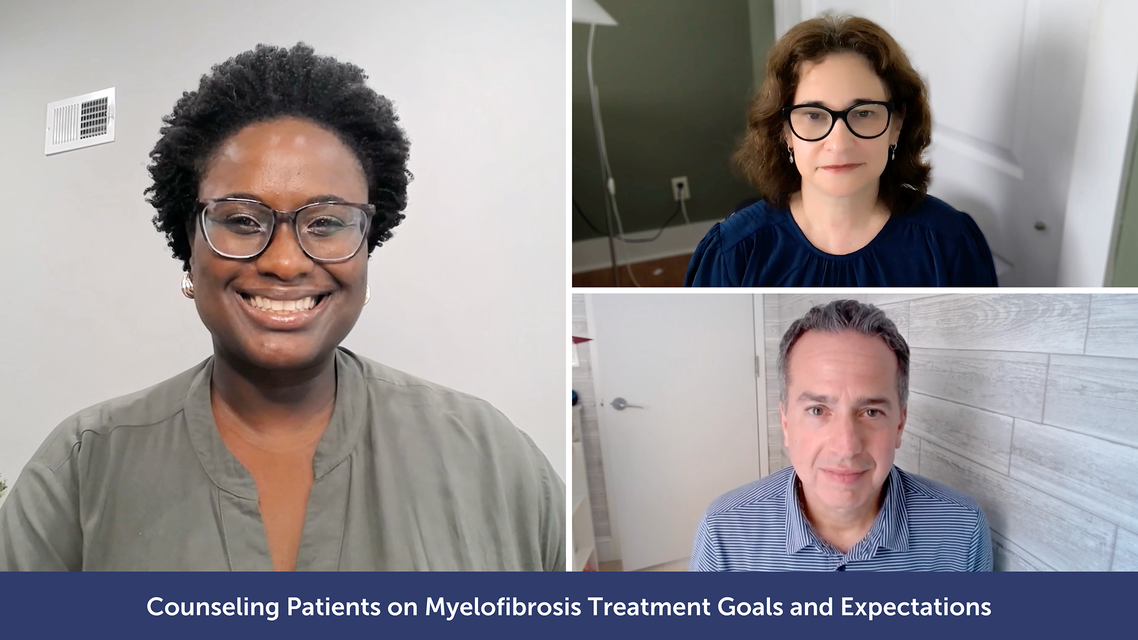
This is Project Oncology on ReachMD, and I'm Dr. Shelina Ramnarine. Here with me today to share communication strategies that can help us set realistic treatment expectations among patients with myelofibrosis are Drs. Marina Kremyanskaya and John Mascarenhas.
Not only is Dr. Kremyanskaya an Associate Professor of Medicine in Hematology and Medical Oncology at the Icahn School of Medicine at Mount Sinai in New York, but she also serves as the Medical Director of the Inpatient Oncology Unit at the Mount Sinai Hospital. Dr. Kremyanskaya, welcome to the program.
Dr. Kremyanskaya:
Thank you so much. It's a pleasure to be here.
Dr. Ramnarine:
Also coming to us from Mount Sinai is Dr. Mascarenhas, who's a Professor of Medicine in Hematology and Medical Oncology at the Mount Sinai School of Medicine and the Director of the Center of Excellence for Blood Cancers and Myeloid Disorders. Dr. Mascarenhas, it's great having you as well.
Dr. Mascarenhas:
Likewise. Happy to be here.
Dr. Ramnarine:
Let's hear from you first, Dr. Kremyanskaya. When you're initiating therapy for a patient with myelofibrosis, what expectations do you consider most important to establish early, and why do those initial conversations have such a significant impact on long-term engagement and treatment success?
Dr. Kremyanskaya:
It's really important for us to establish together the goals of treatment. What are we trying to achieve with the treatment? Is the main goal to improve symptoms or quality of life? Is the main goal to try to get patients to transplant as soon as possible, or is it something else? Is it a specific symptom or sign of the disease that we're focusing on, like anemia and we're trying to improve their hemoglobin? So I think establishing the goal so that we're on the same page with the patient is the most important factor here.
And then I think it's important to establish expectations for both of us. How important is the follow-up? How often do I need to see you? How often do we need to check your labs? And then when do we expect to see these results? When should we say, “Oh, well, maybe this treatment is not working and we should think of something else?” Or when is it too early and we really need to give it a chance? If it's when we're trying to get the patient to transplant, what is the timeline? When we're trying to improve symptoms, we should expect that to happen pretty quickly, but we need to give it a certain amount of time.
So I think those are the really important points to address with the patient when we first start treatment.
Dr. Ramnarine:
And with that in mind, let's turn to you, Dr. Mascarenhas, and examine what counseling looks like in practice. One of the most challenging aspects is helping patients understand that different treatment goals may be achieved on different timelines. So how do you frame expectations around symptom improvement, spleen response, and changes in anemia while acknowledging that individual responses can vary?
Dr. Mascarenhas:
I like to take time to explain what the disease process is, what the etiology or the nature of the disease is, and what the tempo of the disease can be, acknowledging the fact that it's really heterogeneous and variable. No two patients really follow the same path, so it's not always very predictable how the disease will affect any given individual. Some patients can have many aspects of the disease bother them, and other patients have few aspects.
And the same is true with treatment. If we're trying to provide a therapy like a JAK inhibitor for myelofibrosis when we're trying to select a very goal-specific type of therapy—improve symptomatology, reduce spleen, or maybe even overlay another therapeutic that might improve hemoglobin—I think the patients have to understand that although we talk in terms of ‘these are our goals,’ the reality is we don't always achieve these goals to the same extent in every patient. So understand that our treatments are incomplete; they're not perfect treatments, so it can take time to see the spleen reduced, and sometimes patients don't even realize it's reduced. The symptoms sometimes can improve very rapidly, but in other patients, they can take time. So set that expectation.
However, I do want to point out that we don't want patients to think that it's an endless process. So, for example, I think in general, Marina and I tell patients that if we're not seeing symptom improvement by, let's say, three months, that might be a sign that that treatment is not likely to help them from that aspect, and we're thinking about other options. Setting that timeline sets their expectations, so they're not thinking that they're failing a treatment or the treatment's failing them prematurely and they understand what we're going to deliver. And countless times, we've sat with patients to explain, “We're going to give you a JAK inhibitor to improve your spleen symptoms,” but you don't want patients or their families walking away thinking, “Oh, this drug is going to remit my disease or cure my disease,” or “We're going to do a bone marrow biopsy.” So be very clear with the patient on what to expect. In fact, that timeline of what you might expect may not be exactly what the patient actually is going to experience. But there are milestones, and if we don't meet the milestones, we are looking to pivot to other therapies.
Dr. Ramnarine:
Coming back to you, Dr. Kremyanskaya, myelofibrosis is a chronic disease, and for many patients, treatment is intended to be ongoing. So can you share your approach to counseling patients about the expected duration of therapy and having conversations that reinforce the importance of remaining on treatment while response is still evolving?
Dr. Kremyanskaya:
Absolutely. So like you said, it is a chronic disease. Unfortunately, most of the treatments that we're offering are not going to cure the disease except for the transplant. And so the conversation is: the treatment that we're going to try is intended to achieve whatever it is we're trying to achieve—in this case, control myelofibrosis to whatever degree we can.
And so we need to set the expectations—like John mentioned—about the timeline of specific responses. If this treatment works for you, that's great. And so you need to remain on this treatment while it continues to work for you. And we're going to keep assessing that at every visit. Is it working? Is it continuing to work? Is it effective? Are we starting to lose the response? And if we start to lose the response, what could be another option? Do we add something else on? For example, often with certain JAK inhibitors, we see worsening of anemia early on in treatment, but we could potentially add something else on that could help with anemia.
Dr. Ramnarine:
For those just tuning in, this is Project Oncology on ReachMD. I'm Dr. Shelina Ramnarine, and I'm speaking with Drs. Marina Kremyanskaya and John Mascarenhas about effective communication strategies that support shared decision-making, treatment adherence, and realistic expectations in myelofibrosis care.
So as the patient's treatment journey continues, Dr. Mascarenhas, how do you use follow-up visits to review treatment milestones, reassess patient expectations, and support shared decision-making, particularly when a patient's experience doesn't fully align with what they anticipated at treatment initiation?
Dr. Mascarenhas:
I think that happens frequently where we're not always aligned with what we're expecting or our gauge or assessment of how patients are doing. So I would say some patients are very much focused on how they're feeling and the symptoms they might have, and they might be interested in whether we notice a reduction in their spleen on exam. But some are also very focused on numbers, sometimes too focused on their numbers.
So it's not unusual for me to come into the room and I'm like, “Hey, Mr. Jones.” And they're like, “What's my hemoglobin?” And it's right to the chase. So I try to emphasize that the numbers are important, but they're not the sole factor. And sometimes people really fixate on those numbers to a point where I think it just adds a lot of anxiety. I don't think patients often understand the significance of the change in numbers, what that might mean, and they might read into it.
One of the things that I think makes it challenging for us on this side—and Marina and I have had this discussion before—is we live in a world now with MyChart; we broadcast these numbers, and the patients are pinged with it. Sometimes they see it before we do, and that causes a lot of anxiety because there's often no context for them to interpret what these numbers mean. And it really requires, I think, thoughtful explanation and context. To point out what Marina was describing, sometimes we give treatments that address and improve aspects of the disease—spleen and symptoms—but at the same time, can reduce the hemoglobin. And we told the patient in the beginning that low hemoglobin and anemia is an adverse prognostic marker, so we need to move to treat. And then all of a sudden, we're giving them a treatment that's making it worse. But if you don't know the cadence in which that can come down and can come up, it can really frighten the patient.
So it's really a lot about transparency and talking patients off the ledge. I try to help patients resist the urge so they don't look at those labs and fixate on them. Because a really interesting phenomenon that I see is patients will come in, and if you ask them how they're doing before they see their labs, often patients will say, “Pretty good.” But if you ask them, “How are you doing?” after they see the labs, they're like, “Not great. I feel very unwell.” And I'm like, “That's so interesting because I really thought you would give me a different answer before you saw that hemoglobin and that platelet count.”
And what's really interesting and important in this context is that we do reduce blood counts with some of the JAK inhibitors, yet patients will often feel better because of the reduction in inflammation. So decouple those things and make sure patients understand that the numbers don't tell you everything. They're important, but there are a lot of other factors. And when we ask them how they’re feeling, we really want to know the symptomatology rather than the numbers.
Dr. Ramnarine:
Now we're almost out of time for today, so before we close, I'd like to ask each of you to share one counseling strategy that has had the greatest impact on helping your patients remain engaged in their care, especially during periods when improvements may be gradual or less immediately apparent. Dr. Kremyanskaya, let's hear from you first.
Dr. Kremyanskaya:
For some patients, it's helpful to engage with other patients by joining patient support groups and different information sessions. For some people, it's not. They get stressed when there's a lot of focus on certain things. So I think to some degree, patients also have to know what works for them. And we go with whatever works for them. We'll help them get there. We'll point them to the right support groups if they're asking for it, or we’ll say, “You know, maybe you should not look at your numbers too much; let's just discuss it during your visits and see how things go.” So it really is an individualized approach for each patient.
Dr. Ramnarine:
And how about you, Dr. Mascarenhas? Are there communication strategies or shared decision-making techniques that you've found particularly valuable for helping patients maintain confidence in their treatment plans while ensuring expectations remain realistic over time?
Dr. Mascarenhas:
I think both Marina and I have an approach that's similar in the sense that we're both on a journey with the patient to try to help the patient. So staying available to the patient makes a huge difference, whether it's by providing contact information or just that regular follow-up so that they know that they're not just out there taking a medication and not knowing what's next. And I think if you have that close follow-up, patients feel like there's someone who's really watching what's going on and understanding. And you develop that rapport with that patient, and every patient's different.
Dr. Ramnarine:
As those counseling strategies bring us to the end of today's program, I'd like to thank my guests, Dr. Marina Kremyanskaya and Dr. John Mascarenhas, for joining me to discuss how we can help patients navigate their myelofibrosis treatment journey through clear counseling. Dr. Kremyanskaya, Dr. Mascarenhas, it was great speaking with you both today.
Dr. Kremyanskaya:
Thank you. It was a wonderful discussion.
Dr. Mascarenhas:
Great to be here with both of you.
Dr. Ramnarine:
For ReachMD, I'm Dr. Shelina Ramnarine. To access this and other episodes in our series, visit Project Oncology on ReachMD.com, where you can Be Part of the Knowledge. Thanks for listening.