
Transcript
Announcer:
Welcome to Clinician's Roundtable on ReachMD. This episode is sponsored by Exact Sciences, now Abbott. And now, here’s your host, Dr. Shelina Ramnarine.
Dr. Ramnarine:
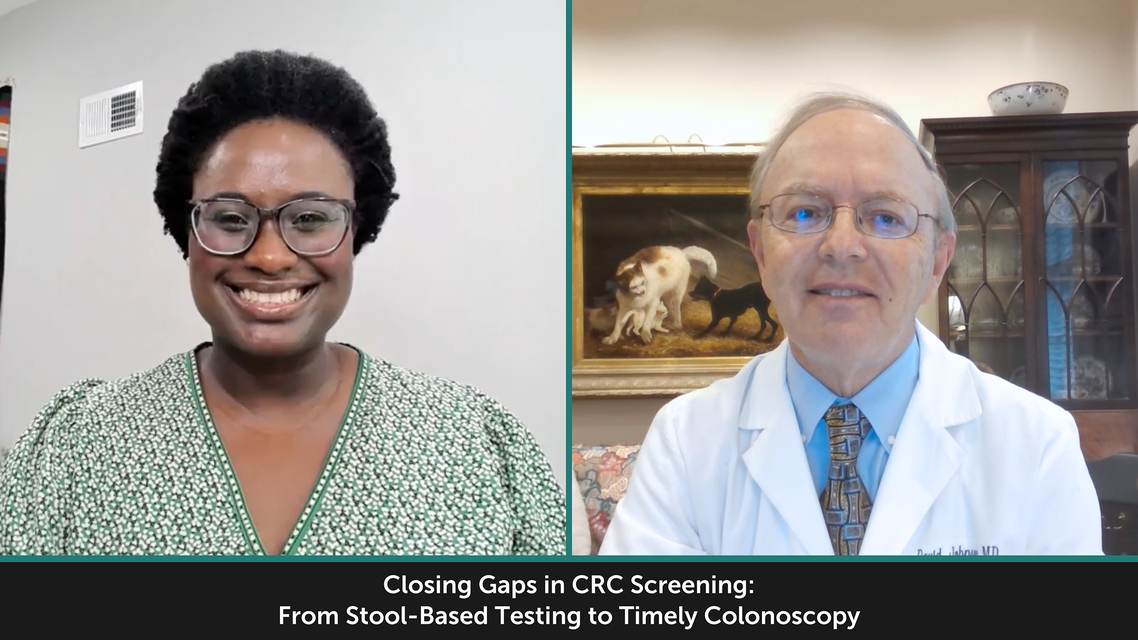
This is Clinician's Roundtable on ReachMD. I'm Dr. Shelina Ramnarine, and joining me to discuss how we can improve follow-up after abnormal stool-based colorectal cancer screening tests is Dr. David Johnson. He's a Professor of Medicine and Chief of Gastroenterology at Eastern Virginia Medical School at Old Dominion University.
Dr. Johnson, thanks for being here today.
Dr. Johnson:
I look forward to our conversation.
Dr. Ramnarine:
So to start us off, Dr. Johnson, we're seeing an increased use of stool-based screening tests for average-risk patients, but its effectiveness depends on patients completing a timely follow-up colonoscopy after an abnormal result from stool-based testing. How is that follow-up step playing out in your practice?
Dr. Johnson:
The problem that is emerging is the discordant link. If you order the test, it needs to be with the inherent understanding that a colonoscopy is part of that, because if it's positive, the risk of colon cancer is inordinately increased. What do I mean by that? Well, positive tests for virtually all these things are basically a cancer detection test for things like the serum-based test. FIT test is basically a colon cancer test. Advanced polyps we're finding that need to be removed, the numbers increase for the stool-based testing with DNA and the newer one with RNA about the same, about 42 to 44 percent. Those need to be removed before they become cancer.
And the whole goal of colon cancer screening is not detection; it's about prevention. So the more we can get involved in that and be proactive in completing that link—you order the test, but the patient needs to understand that means if it's positive, we go to colonoscopy.
Dr. Ramnarine:
Now, a recent study out of an integrated health system found that only 59.6 percent of patients with a positive stool-based test completed a follow-up colonoscopy within 180 days, which is well short of the 80 percent completion target set by national guidelines. What are the clinical consequences when that follow-up step is delayed or missed, particularly when we look at long-term patient outcomes?
Dr. Johnson:
I will tell you that number, 59 percent, depends on who they looked at and where they looked. And the studies that I've seen may be as low as 13 percent. They may be higher when you go to places that have integrated healthcare and closed-loop systems. By that I mean you order the test, it comes back positive, and you've got navigation strategies to get that colonoscopy done. Kaiser Permanente and Geisinger—those are the best of the best that may get 80 percent in the best-case scenario back within a period of time.
And the period of time is really important because once you define that test being positive, the incremental yield of colon cancer and advanced colon pre-cancer lesions increases. The US Preventive Task Force, of which I was a member for seventeen years, and the American Cancer Society have recommended that repeat follow-up with a colonoscopy be done within 180 days—six months. Ideally, shorter than that. But when you have a positive test, you no longer have a screening test. That screening test is not complete until they have a colonoscopy. If we find that they go past that six months—so start at three months, which is where we try and do it in my practice, we would prioritize that patient coming in within three months for their colonoscopy—six months, there's really a timeline where the numbers start to really increase as far as cancer incidence or cancers that are missed if you don't do it before six months.
But there also are progressions of cancer. So when we look at colon cancer in itself, it's still a treatable disease and a curable disease.
Particularly, we start to look at curable disease by surgery or even excavation by a colonoscopy for superficial lesions. Stage one or stage two cancers still have an extraordinarily high percent of patients that are "cured." But advance in that stage of disease is evident once you get past six months and nine months and one year. And with that comes increased risk for colon cancer-associated mortality.
So we've got to put this into priority. A positive test gets colonoscopy, but it's not just whenever. It's got to be prioritized. So it's not just a response to a lab test; it's a high-risk indication that there's something going on potentially.
Dr. Ramnarine:
The same analysis identified several common reasons patients didn't complete timely follow-up colonoscopy, including office visits not being scheduled or completed, patient refusal, and colonoscopy no-shows or cancellations. So in your experience, what's driving these challenges?
Dr. Johnson:
There are probably three categories that I would look at: patient factors, evidence of practice or provider factors, and healthcare system factors. When looking at this in some of the literature, they've identified specifics that the colonoscopy was never scheduled probably 19 percent of the time. No-shows or cancellation, 28 percent. Those patients who refused after the recommendation for colonoscopy is around 16 percent. In this particular study, patients refused before the referral—"I'm not going to get colonoscopy independent of what ID I get"—nine percent. And the one that really scared me was that about seven and a half, close to eight percent of patients were never notified of their positive tests.
So you have to look at what fits the individual system. So if you have patient factors—their fear of colonoscopy or anesthesia, why they didn't agree with the screening colonoscopy to begin with a reluctance to undergo a bowel prep, which we've written a lot about—it’s something that really needs to be navigated through this. And certainly the way to best do that is through provider and patient factors, where you can mitigate some of those concerns, help accelerate the colonoscopy, or have a reflex positive referral to gastro when the test is positive. And really, the healthcare system factors really play into it too.
What's your navigation strategy? A nurse navigator on this is really important. A closed loop system which keeps that on your electronic medical record that says, “This is not closed until we close it by discrimination that they got a colonoscopy, and that was done to finalize.” And if we look at the people who don't come back after they have a positive test, the numbers varied based on some of the underserved areas, maybe as low as 30 percent. Some of the patients who never get a colonoscopy may be a little bit higher in some situations.
But the key is almost 25 to 30 percent of patients with a positive screening test never get their follow-up colonoscopy. That's pretty scary when you talk about the cancer incidence that we talked about, the cancer prevalence when you have that detected, and that those people with positive tests initially may be 2 to 4 percent for across all these screening tests. The precancerous lesions, which are not well detected by FIT, and about 13 percent of advanced precancerous lesions by the blood test. And when you get into the stool-based testing with the stool DNA and stool RNA, the numbers go up to around 42 to 40 percent. Those are precancerous.
Again, prevention is the whole strategy. Resection of those things is really important. But of all these tests, 25 to 30 percent never come back for colonoscopy, even though you have potential strategies to not only prevent but cure.
Dr. Ramnarine:
For those just joining us, this is Clinician's Roundtable on ReachMD. I'm Dr. Shelina Ramnarine, and I'm speaking with Dr. David Johnson about improving patient follow-up after abnormal stool and serum-based colorectal cancer screening tests.
So Dr. Johnson, we know screening is an ongoing process, not a one-time event. But once patients complete a diagnostic colonoscopy after a positive stool-based test, some may assume they're finished with screening, especially if the colonoscopy is normal. How can primary care providers help patients understand that screening is an ongoing process and reinforce the importance of returning for future screening?
Dr. Johnson:
The patient needs to understand that this is not a one-time test. Colon cancer increases with age, increases over time, and increases with lack of, of early detection. So when these tests are done, they need to be understanding that there are limits of even the intervals for detection. So if you have FIT testing, it's got to be done annually. The stool DNA and RNA, that's done every three years. The serum-based testing is done every three years. Although, again, the precancerous detection risk is a very serious downfall for that one.
And colonoscopy is done every 10 years, so it's the best test for prevention. But it's critically dependent on who performs the colonoscopy. We have quality indicators—a report card, if you will—that we challenge ourselves with that say, "You need to have a minimum level of detection."
If you come in now with a positive stool test or serum test in particular, the numbers for quality in our specialty go up to 50 percent.
Dr. Ramnarine:
If we look beyond individual patient encounters, what practice or system-level changes, whether it's staffing, technology, or care coordination, do you think could have the greatest impact on improving timely follow-up after abnormal stool-based screening test?
Dr. Johnson:
I would say that it depends on where you are. And system-wide support for this, as opposed to a rural community that won't have the integrated systems, perhaps, but a nurse navigator or a patient navigator—doesn't have to be a nurse. But somebody who drives through automatic referrals for a positive test to a gastroenterologist for a colonoscopy, making sure it's a high-quality gastroenterologist. The high quality does make a difference. But closing that loop and keeping that loop open until it's sanctified, and then ensuring the patients understand when they get the test, if it's positive, it really equates to an absolute need for a colonoscopy because a lot of these patients would have chosen a "non-invasive test" because they didn't want to go through a colonoscopy. So there may be a pre-selection bias against that, but reassuring them that if it's positive, we'll do a baby step here, but if it's positive, we really need to go to the next level because that's where cancer detection, and particularly more cancer prevention, really hits the mark.
Dr. Ramnarine:
Before we wrap up, Dr. Johnson, what key takeaways do you want primary care clinicians to take away from our conversation when it comes to improving patient adherence and follow-up?
Dr. Johnson:
One would be that colon cancer screening, if you look at serum-based or stool-based testing, is a two-step process. One is to do the test, but the second step is a colonoscopy is critically important if it's positive.
Second point would be to set expectations before ordering the test. “We're not getting you out of a colonoscopy. Understand a negative test means you still have to come back, be it a stool-based FIT test that comes back annually. But the other stool-based tests and even the serum test require a recommended interval concurrent with that, which is every three years. You're going to have to come back for colonoscopy if it's a positive test.”
Third is choose the screening strategy they’re most likely to complete. Again, I always start with colonoscopy. That's the best test. But if they don't, then let's walk it down. But pick something because something is better than nothing. But follow-up of that without colonoscopy is basically close to nothing.
Fourth point is a positive test doesn't warrant a repeat of the same test. A positive's a positive. It's not going to change if you come back negative because the variability of these tests is such that a positive needs to be equated as a real positive until we rule it out and further pursue it with a colonoscopy.
The fifth point would be don't rely on passive follow-up. “I told the patient they needed a colonoscopy. I told them to call and get a gastroenterology referral.” You really need to have an active tracking system to really maintain that and it's not relying solely on the patient’s initiative.
And the sixth point would be a closed-loop workflow. So if you have an EMR that can set this up, it's the best way to do that. But leave that as an active problem, so you can track and see and monitor when they come back to do that.
The next point would be strengthening relations with gastroenterology. A positive referral from primary care equals a colonoscopy evaluation, be it a Zoom visit or direct access. That would be really important.
And then the final point is measuring your performance. Quality matters. How often are you actually seeing that test follow-up? The completion of a colonoscopy is reflective of your practice.
So the overall message that I would give to you is, at present, the greatest opportunity to improve colorectal cancer outcomes is no longer just simply increasing screening rates. It's ensuring that every stool-based positive test results in a timely and high-quality colonoscopy through reliable and team-based and a closed loop approach.
Dr. Ramnarine:
That's a great way to end our discussion, and I'd like to thank my guest, Dr. David Johnson, for joining me to explore these strategies for improving patient adherence to colorectal cancer screening pathways.
Dr. Johnson, it was great having you on the program.
Dr. Johnson:
With pleasure and hopefully helpful to the listeners.
Announcer:
This episode of Clinician's Roundtable was sponsored by Exact Sciences, now Abbott. To access this and other episodes in our series, visit Clinician's Roundtable on ReachMD.com, where you can Be Part of the Knowledge. Thanks for listening!