
Transcript
Announcer:
Welcome to Clinician's Roundtable on ReachMD. This episode is sponsored by Exact Sciences, now Abbott. And now, here’s your host, Dr. Brian McDonough.
Dr. McDonough:
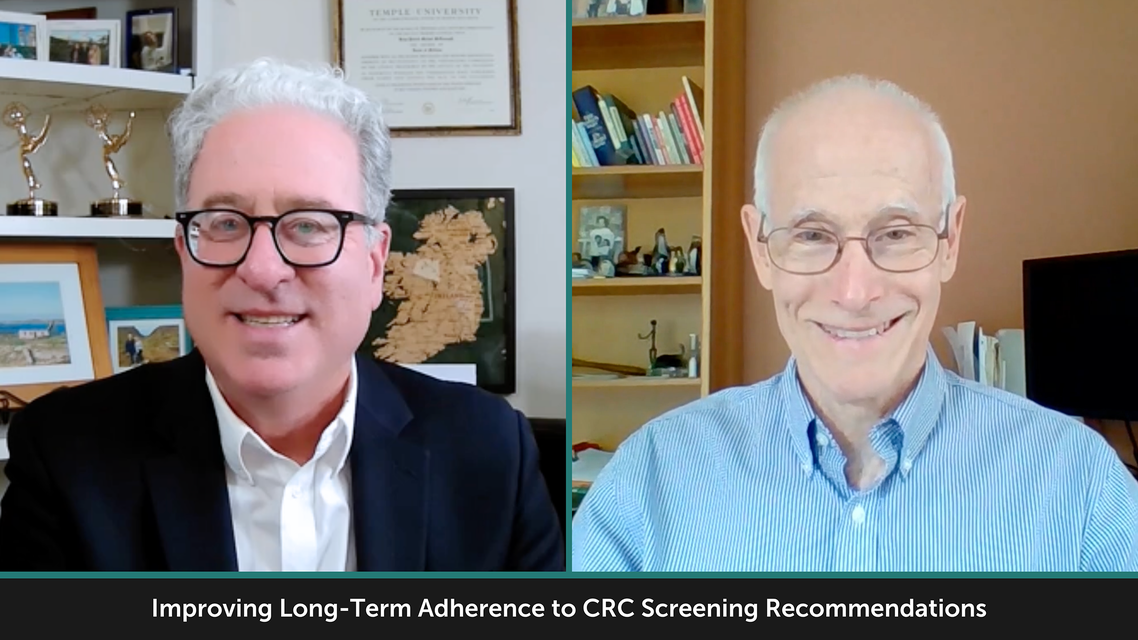
Welcome to Clinician's Roundtable on ReachMD. I'm Dr. Brian McDonough, and joining me to discuss how long-term colorectal cancer screening adherence can impact patient outcomes is Dr. David Lieberman, Professor Emeritus in the Department of Medicine and former Chief of the Division of Gastroenterology and Hepatology at Oregon Health & Science University in Portland.
Dr. Lieberman, thanks for being here today.
Dr. Lieberman:
Well, thank you for having me.
Dr. McDonough:
When we compare colorectal cancer screening options, we often focus on how individual tests perform in a single screening round. But we know patients should be screened repeatedly over time regardless of the modality. So if we evaluate screening approaches primarily based on individual test performance, what long-term considerations might we overlook?
Dr. Lieberman:
We have great evidence that a number of different screening tests are associated with reductions in the risk of developing colon cancer and the risk of death from colon cancer. So this is exciting, and it makes the case, I think, for uniform screening of average-risk individuals and, of course, high-risk individuals.
So the question about the test performance, each of these tests has somewhat different performance characteristics. So that some tests may detect precancerous polyps more effectively than others. Some may detect early-stage cancer more effectively than others. But at the end of the day, adherence to the screening, whatever test it is, is probably one of the most important variables that defines whether a program is going to be effective or not. So I know it sounds like common sense, but if a patient doesn't complete the test, then it's not going to be effective.
So we have, um, a number of tests where patients need to come back for repeat testing. And the data about repeat testing suggests that this is a problem for some of the screening modalities. So we know that for stool testing, for example, the tests are recommended to be repeated at appropriate intervals. And we know that in real-life practice—and the best data exists for FIT—there's a drop-off in the completion of the FIT tests on a regular basis. So for FIT testing, we recommend that the test be done every year. And the reason for that is that we know that this test is not 100 percent sensitive for detection of cancer. So you may have cancer, and the test could be negative in one year. But if the test is repeated in the following year, we know that there's evidence that early-stage cancer can still be detected, and so the program can be effective. If patients do not come back for repeat testing on a regular basis—we call that intermittent testing—then we know that there is a higher risk that they may develop colon cancer and that they may die of colon cancer.
So adherence has been shown in several studies now to be a very important element of programmatic success. For the stool DNA tests and the stool RNA tests, the current recommendations are that these tests should be repeated every three years. We don't have as much data about how often patients actually complete these tests and what the consequences of not repeating those tests might be. But I think we can extrapolate from the FIT experience that it's going to be really important that these tests be repeated at appropriate intervals to contribute to an effective program.
Dr. McDonough:
So let’s take a closer look at how that plays out in the real world. In one study, Halm and colleagues followed patients across four health systems for up to ten years and found that only about half consistently kept up with stool-based screening over time, while others drifted into inconsistent testing or stopped altogether. And colonoscopy has its own adherence gap; another study found that nearly half of patients due for follow-up colonoscopy after a large polyp removal were lost to follow-up entirely. From your perspective, what are the biggest barriers that cause patients to fall off track over time?
Dr. Lieberman:
I think there are several possible reasons. One is that when patients have a test and it's normal, they may feel, "Oh, I checked the box. I've done the screening that has been recommended by my primary care doctor. I don't need to do this again." And so it emphasizes the importance of education at the beginning so that patients understand that the test is not perfect and that it should be repeated on a regular basis.
The second is creating a reminder system, and I think that goes two ways: a reminder system for the patient to complete the next test at the appropriate interval, and a prompt to the primary care physician.
The third barrier, I think, is that patients struggle sometimes with our uncoordinated medical system. And so getting from a doctor's office to the appropriate test and getting it done can be a frustration for them. But where I think this really comes into play is with patients who have a positive test, and they need to have a colonoscopy. That requires some coordination of care between a primary care physician and a gastroenterologist, and so that is sometimes a barrier for individuals. And that's where navigation can be very important.
Dr. McDonough:
Building on that, a modeling analysis by Dore and colleagues compared three rounds of stool-based DNA testing to a single screening colonoscopy over a 10-year period using real-world adherence instead of assuming perfect completion. Although colonoscopy detected precancerous lesions more effectively in a single exam, the repeated stool-based strategy still detected more cancers overall, reduced mortality further, and gained more life years cumulatively. Given those findings, how do you think the characteristics of these modalities may inform adherence over time?
Dr. Lieberman:
In the model that you mentioned, one of the assumptions made was that the rate of completion for colonoscopy was low, whereas the rate for completion of the stool test was higher. And in that kind of scenario, we shouldn't be surprised that the stool test might have been somewhat more effective. There are currently several studies going on around the world comparing a stool test with colonoscopy. So there's a large study called the SCREESCO Study; that's in Europe. And then there's a large study in the United States in the veterans system comparing FIT and colonoscopy. And one of the things we hope to learn from those studies is what happens in real-world situations when these studies are compared.
So without those studies to inform us right now, we can look at models like the one that Dore presented. And I think that this model reinforces something that we already knew, and that is that colonoscopy won't work if it's not completed. We learned this from another European study called the Nordic Trial. So this was a very important study that compared a colonoscopy to usual care, so they're not comparing it to a stool test. And in this study, individuals were sent a letter informing them that they would be offered a colonoscopy as part of colon cancer screening. And the other similar age and sex-matched individuals got no such letter and were just followed in their primary care clinic. What was discovered in this study was that of the patients offered a colonoscopy, only 42 percent completed that colonoscopy. And so the results suggested that the outcome for patients who have had colonoscopy was still better than no screening at all, but it was not nearly as high as we might have expected in terms of colon cancer prevention and colon cancer death reduction, highlighting this very important point that in any screening program, the test is going to need to be completed fully in order to have an effective program.
One other point I'd like to add about colonoscopy itself is that we have learned over the last decade or so that the quality of colonoscopy is an important element of every screening program. So for stool-based programs, if the test is positive, the patient will be referred to colonoscopy. In a colonoscopy screening program, they will have a colonoscopy. So it's going to be very important that whoever performs that colonoscopy is performing it with high quality. That means a complete exam with an adequate detection rate for important polyps in the colon.
Dr. McDonough:
For those just tuning in, you're listening to Clinician's Roundtable on ReachMD. I'm Dr. Brian McDonough, and I'm speaking with Dr. David Lieberman about longitudinal adherence to colorectal cancer screening recommendations.
Let's shift from why long-term adherence matters to how we can actually improve it in practice. We recently saw results from twenty years of Kaiser Permanente Northern California's organized screening program, where completion rose from 37 percent to nearly 80 percent, deaths from colorectal cancer were cut in half, and long-standing racial disparities and outcomes were nearly eliminated. Given those impacts, what do you see as essential elements of a successful organized screening program?
Dr. Lieberman:
So this study, I think, is one of the more important studies that's been published in the last few years because it does demonstrate that in an organized program, you can achieve the results that we're hoping for, which is a reduction in colon cancer, risk and mortality, and also an elimination of disparities.
So what are the key elements of that program that made it work? One is access for everyone. Every person in the Northern Kaiser program had access to screening, and they were encouraged by their primary care providers to have screening.
And then the second factor, a subject that I alluded to earlier, is navigation. When patients were sent screening tests and did not complete them, they would get a reminder, a phone call, an email, or a text reminding them to complete the test. And so that was another key element.
So access for everybody and navigation. And then the third part of the program, which I think did contribute to the reduction in mortality and colon cancer incidence, is the follow-up after a positive test. So in this study, they demonstrated that they could achieve an 80 percent rate of finishing a colonoscopy after a positive stool test. And this is quite a bit higher than had been published in other community-based studies. So I think this demonstrates the importance of navigation and how that can make a difference.
Dr. McDonough:
Taken together, the modeling evidence and real-world data suggest that long-term colorectal cancer screening effectiveness really depends on more than just the performance of an individual test. So when we're considering all these factors in real-world practice, how should we counsel average-risk patients and tailor our recommendations to promote long-term adherence?
Dr. Lieberman:
This is part of the educational process that needs to take place between the primary care provider and the patient. First is to think of screening programmatically. In other words, it's not just a single test, but that patients will have repeat testing if that initial test is normal, and they will need a colonoscopy if the test is abnormal.
The second, as I mentioned earlier, is to leverage the electronic health record to provide prompts to the primary care physician that say, "You are due for your colon cancer screening. Here are the screening options." And we know that that can be done through an electronic health record system.
And then the third is creating incentives for the primary care provider and the healthcare system to complete the continuum with screening. And so by that, I mean patients who have a non-invasive test—a stool test or a blood test—and if it's positive, should get to colonoscopy.
And there are going to be new HEDIS requirements—quality metrics—that will include the completion of a colonoscopy after a positive non-invasive test. I think that's an exciting development that will improve adherence for the continuum of screening that we need.
Dr. McDonough:
That's a great comment for us to think on as we come to the end of today's program. I want to thank my guest, Dr. David Lieberman, for joining me to share his perspectives on how we can improve cumulative colorectal cancer screening effectiveness.
Dr. Lieberman, it was great having you on the program.
Dr. Lieberman:
Thank you, and thank you for the opportunity to reach out to your audience.
Announcer:
This episode of Clinician's Roundtable was sponsored by Exact Sciences, now Abbott. To access this and other episodes in our series, visit Clinician's Roundtable on ReachMD.com, where you can Be Part of the Knowledge. Thanks for listening!