
Transcript
Announcer:
Welcome to CE on ReachMD. This activity is provided by Prova education and the National Comprehensive Cancer Network. This episode is part of our MinuteCE curriculum.
Prior to beginning the activity, please be sure to review the faculty and commercial support disclosure statements as well as the learning objectives.
Dr. Patel:
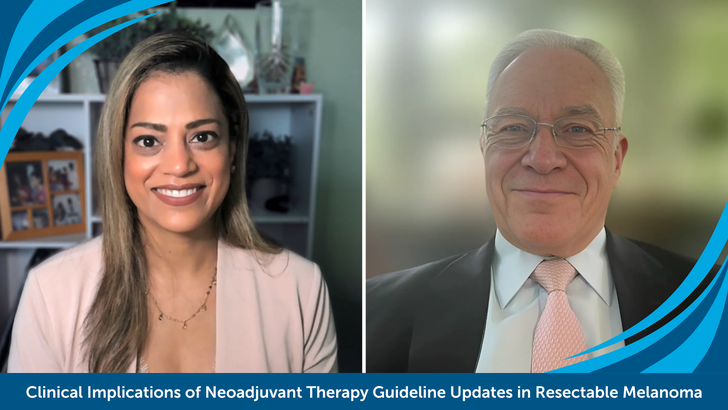
This is CME on ReachMD, and I'm Dr. Sapna Patel. Here with me today is Dr. John Kirkwood.
Dr. Kirkwood, we just had a nice conversation about neoadjuvant therapyregimens. What can you tell us about the clinical significance of the updated guidelines, but perhaps more importantly, this idea of getting to medical oncology before surgery?
Dr. Kirkwood:
Thank you, Dr. Patel. I think for already 40 years in Pittsburgh, we have adopted a policy of multidisciplinary evaluation for virtually every patient we see. And this is something that, I think, with the advent of neoadjuvant therapy becomes critical. So patients that come in either to our surgeon or to our dermatologists or to us in medical oncology, we share with our colleagues to have multidisciplinary input. The consideration for a patient who comes in with bulky nodal disease is immediately, neoadjuvant therapy. The feasibility and the adjuvant therapy demands the medical oncology assessment of that patient. Hopefully the dermatologists become involved in this and are able to refer and consider this kind of an approach in the multidisciplinary setting, in a tertiary referral center, because this is where I think optimal care is currently available.
The eligibility, obviously, is colored by many facets of the patient's own makeup—the patient with severe underlying autoimmune disease, transplants, a bunch of other things that I know you and certainly I see frequently in the company of melanoma—make it more difficult to give neoadjuvant therapy. But the patient needs to be informed of the options, and I think our surgeon needs to determine the surgical feasibility of resection. And sometimes a patient will present with what might be considered marginally resectable disease. This, in the past, might have dissuaded us from giving medical intervention first. I think now it may be the ticket to consider even more intensely the neoadjuvant options that we have with us.
The opportunity to reduce recurrent risk with therapy given before surgery, when the tumor is in place and the tumor serves as the antigen reservoir that the immune system of the patient treated with checkpoint blockade can leverage to their advantage. Obviously a year ago, the advent of the NADINA trial and the striking reduction in recurrence events and events overall, with combined checkpoint blockade, made that also an option that patients need to know about, need to participate in the decision about whether to pursue or not.
And I guess I'd love to hear your thoughts on neoadjuvant therapy and outstanding questions that we haven't addressed.
Dr. Patel:
Yeah, I think that's such a great summary, but it really highlights that we have to have multidisciplinary care with this now early resectable melanoma. It used to be a real linear approach, right? They would be dermatology, go to surgery, and then end up in medical oncology. But now we're actually going to be passing the patient back and forth a little bit. Everyone involved needs to know that this case is a neoadjuvant case. So the surgeon needs to know, pathologist needs to know. Everybody handles their role slightly differently than if this was just a routine, standard, definitive surgery.
What S1801 showed us is, exactly as you said, you can take the same regimen, maybe just sequence it differently, and improve outcomes. And NADINA said, well, what if we even get smarter and minimize the regimen? Maybe everybody doesn't need as much therapy. And so they're asking the question, can we de-escalate adjuvant therapy? The next obvious step is, can we de-escalate surgery? And those trials are being developed to see, can we do less of the big surgery? Particularly, as you noted, if somebody with bulky disease actually shrinks their cancer, can they actually have a smaller surgery than was originally planned?
I think this role of pathological response is an outstanding question, because can our community pathologists read the tissue or process the tissue in the same way that you might do it on a clinical trial? Is it cost feasible for them to take that kind of time and do it? We also have to recognize that pathological response is an estimate of a residual tumor bed. And it's actually an estimate of the original tumor bed.So then we apply these very precise cutoffs of 10% for major pathologic response, 50% for partial. We apply these very precise cutoffs for an imprecise, what is clearly an estimate of tumor bed. These are all the things we're wondering as we phase neoadjuvant care, I think, into our clinical practice. But importantly, as you highlighted, multidisciplinary care is the key to this being a successful regimen.
I'm so glad to have this talk with you, Dr. Kirkwood. Thanks for tuning in.
Announcer:
You have been listening to CE on ReachMD. This activity is provided by Prova education and the National Comprehensive Cancer Networkand is part of our MinuteCE curriculum.
To receive your free CE credit, or to download this activity, go to ReachMD.com/Prova. Thank you for listening.