
Transcript
Announcer:
Welcome to CE on ReachMD. This activity is provided by Prova education and the National Comprehensive Cancer Network. This episode is part of our MinuteCE curriculum.
Prior to beginning the activity, please be sure to review the faculty and commercial support disclosure statements as well as the learning objectives.
Dr. Ascierto:
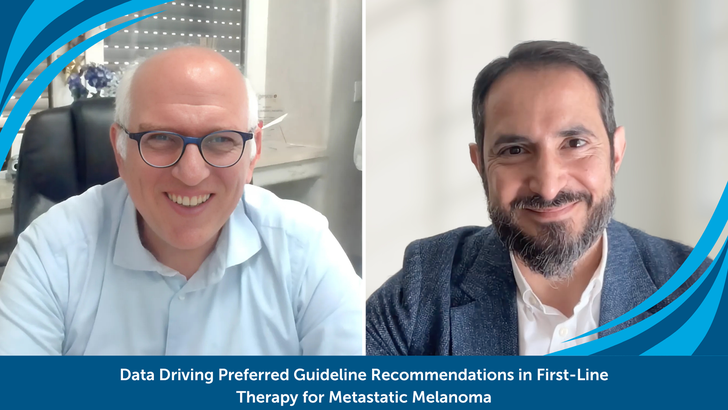
Hi, everybody. This is CME on ReachMD, and I'm Dr. Paolo Ascierto. Here with me today is an important key opinion leader in the field, a good friend of mine, Dr. Hussein Tawbi.
Dr. Tawbi, what can you tell us about the data driving preferred guideline recommendation in first-line therapy for metastatic melanoma?
Dr. Tawbi:
Thank you, Paolo. Always good to see you. And really exciting to share that in the first-line setting for metastatic melanoma, we continue to have evolution, and we continue to have new options for our patients. We'll review data from 3 important trials. One would be the CheckMate 067 trial, the RELATIVITY-047, and also the DREAMseq trial, which allowed us to think about sequencing of treatment.
So in general, I will tell you that we've been very happy to have checkpoint blockade in metastatic melanoma, where we can now offer long-term benefit, almost cures, for our patients with metastatic disease. And that started with single-agent ipilimumab that showed about a 22% long-term survival for patients. And so CheckMate 067 was a study that was designed to show that single-agent PD-1, or the combination of CTLA4 and PD-1, were superior to single agent CLTA-4. And that study with almost 950 patients, has now 10 years’ data that shows us, without any question, that the PD-1-based approaches are superior to CTLA-4 alone.
It also shows a slight benefit for ipilimumab and nivolumab combination. We know that it gives us a higher response rate. The PFS seems slightly better than single-agent PD-1, and the OS looks slightly better, although not statistically significant. And just to be clear, that study was never designed to compare IPI and NIVO to single-agent PD-1 head-to-head.
So, that's where RELATIVITY-047 is really interesting. It's the combination of nivolumab and the LAG-3 antibody relatlimab, compared to single-agent PD-1 in the form of nivolumab. And that was a 714-patient trial, double-blind, randomized placebo-control, and it was head-to-head. And it actually showed direct superiority of the nivolumab/relatlimab combination over single agent, both in terms of PFS, almost doubled the PFS, and in terms of response rate, about 10% increase in the response rate. And we see some impact on survival, which is technically not statistically significant, but you see that even with that a hazard ratio of 0.77 now in the 4-year data, the confidence interval does not cross 1 for the hazard ratio. So we’re kind of looking at a potential impact on survival, as well.
Probably, the main difference between those 2 combinations is not necessarily efficacy, because there's mounting evidence that they look really comparable, but really toxicity. We know that IPI/NIVO gives you up to 55% to 60% Grade 3/4 toxicity and sometimes more than one Grade 3 toxicity per patient. And nivolumab and relatlimab gives you only about the 22% grade 3/4 toxicity. So I have those two options for me in our patients with metastatic melanoma. I rarely go to single-agent PD-1, Paolo, because now we have randomized, double-blind evidence that combinations are superior to single-agent PD-1. However, you could imagine that that is a regimen that's available to you. If there are really compelling reasons to use single agent, like major comorbidities, autoimmune disease, some other reason to do it, you possibly can. But really, combination immunotherapy is the standard.
The other data is, if you have a patient with a BRAF-mutant metastatic melanoma, of course you can reach the targeted therapy. And we have 3 combinations—dabrafenib/trametinib, vemurafenib/cobimetinib, and encorafenib/binimetinib—all FDA-approved in that setting. But the DREAMseq trial was a trial that compared IPI/NIVO first to the dabrafenib/trametinib first, and then switch at progression. And there was a 20% survival benefit in favor of immunotherapy, which is why we kind of really reached to immunotherapy as a first-line option, almost for all patients.
And we have a trial that was ran by my good colleague, Dr. Ascierto, that did show that in some cases, you could use 8 weeks of targeted therapy and then switch to combination immunotherapy in very specific situations.
Paolo, do you want to comment on that?
Dr. Ascierto:
So thank you, Hussein, for this great overview about what we have at the moment available in the first-line metastatic melanoma. And I fully agree with you, that this moment in immunotherapy, surely the most important treatment that should be given as first. You mentioned the DREAMseq and the SECOMBIT, which is the other trial which clearly demonstrated that immunotherapy first is better.
And having said that, so this was surely a great discussion. Our time is up, and I'd like to thank all of you for listening to us. Thank you, again.
Announcer:
You have been listening to CE on ReachMD. This activity is provided by Prova education and the National Comprehensive Cancer Networkand is part of our MinuteCE curriculum.
To receive your free CE credit, or to download this activity, go to ReachMD.com/Prova. Thank you for listening.