
Transcript
Announcer:
Welcome to CE on ReachMD. This activity is provided by Prova education and the National Comprehensive Cancer Network. This episode is part of our MinuteCE curriculum.
Prior to beginning the activity, please be sure to review the faculty and commercial support disclosure statements as well as the learning objectives.
Dr. Kirkwood:
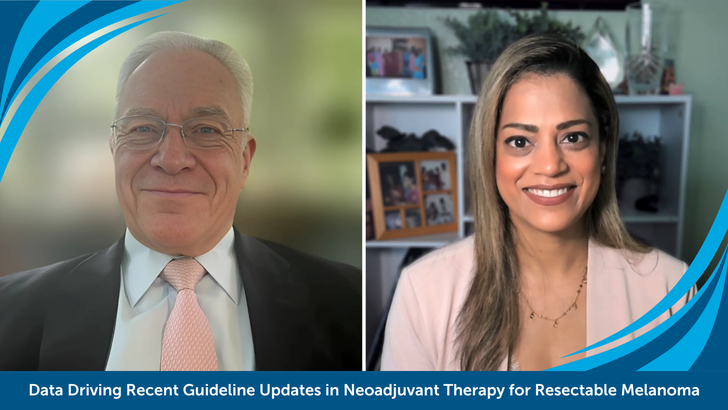
This is CME on ReachMD, and I'm John Kirkwood. Here with me today is Sapna Patel.
Dr. Patel, can you provide an update on the data driving recent guideline updates in the neoadjuvant therapy of resectable melanoma for us?
Dr. Patel:
Sure, Dr. Kirkwood, thanks for that question. Neoadjuvant therapies are now being used for resectable stage III melanoma, and in some instances, maybe even resectable stage IV, so oligometastatic disease. We have some original data from the OpACIN and PRADO studies. These were non-randomized studies but showed us that you can safely and feasibly administer systemic therapy before surgery. In the case of OpACIN and PRADO, they used inverted dosing of ipilimumab and nivolumab, so 1 mg of ipilimumab plus nivolumab 3 mg/kg, or in some instances, just a flat 480. And they did it for 2 cycles and then proceeded to surgery. The key there was that surgery happened around week 6.
And then we have 2 randomized trials that actually have efficacy data, and those trials are the SWOG S1801 study. This was a randomized phase 2 trial of 3 doses of single agent pembrolizumab given before surgery. And so that was given around weeks 0, 3, and 6, and surgery could occur any time after week 6, so between weeks 7 and 12. And then that was followed by 15 doses of adjuvant pembrolizumab. And that was compared to the standard approach, which would be surgery and 18 doses of adjuvant pembrolizumab. And that approach showed that the 3 preoperative doses followed by 15 postoperative doses led to better outcomes, what we call event-free survival outcomes in the patients who received the perioperative or neoadjuvant regimen.
That study was soon followed by the NADINA study, a randomized phase 3 trial that randomized patients again to the standard approach of surgery followed by 1 year of adjuvant nivolumab or this OpACIN/PRADO regimen of 2 doses of flip dose ipi/nivo followed by surgery. And then they personalized the adjuvant therapy based on response at the time of surgery. In other words, patients who had a major pathological response were finished. There was no adjuvant therapy. And those that had anything less than a major pathological response, partial or nonresponse, went on to receive adjuvant therapy. In the case of BRAF mutation, those patients had a planned switch to adjuvant BRAF/MEK in the face of a nonmajor pathological response. That study also, NADINA, demonstrated an improvement in event-free survival over the standard adjuvant approach.
These 2 randomized trials really give us confidence that putting systemic therapy in front of surgery does not lead to inferior outcomes. We're not causing harm in these patients. In fact, we're benefiting those patients and really probably saving lives, shortening their therapy, etc.
There are some other regimens that can be considered. Certainly, single-agent nivolumab has been studied, not necessarily randomized in an efficacy basis. And then nivolumab/relatlimab, in a single-arm study, was shown to also to have a signal in terms of major and complete pathological response, but non-randomized. And then the one study that's presented overall survival data so far is neoadjuvant T-VEC. That regimen of T-VEC before surgery has both a recurrence-free, event-free survival benefit, but also an overall survival benefit.
And we know from kind of pooled analysis around the world, while we can give targeted therapy in the neoadjuvant setting, it tends to have inferior outcomes to immunotherapy, even in the face of complete pathological responses, so we tend to reserve neoadjuvant therapy for more immune-based treatments and really solely immunotherapy.
Dr. Kirkwood:
Thank you so much, Sapna. That was really very informative, and I think, shows the pace at which progress has come over the past year or 2. And there were obviously multiple other studies presented at ASCO that were of interest.
I think these data inform the practice of oncology and the consideration of neoadjuvant therapy only a few years ago, not on the agenda for most people outside of trial, now become a consideration as standard of care for many of our patients.
Well, I think we've had a great review. Our time is up. Thank you all for listening.
Announcer:
You have been listening to CE on ReachMD. This activity is provided by Prova education and the National Comprehensive Cancer Networkand is part of our MinuteCE curriculum.
To receive your free CE credit, or to download this activity, go to ReachMD.com/Prova. Thank you for listening.