
Transcript
Announcer:
Welcome to CE on ReachMD. This activity is provided by Prova education and the National Comprehensive Cancer Network. This episode is part of our MinuteCE curriculum.
Prior to beginning the activity, please be sure to review the faculty and commercial support disclosure statements as well as the learning objectives.
Dr. Tawbi:
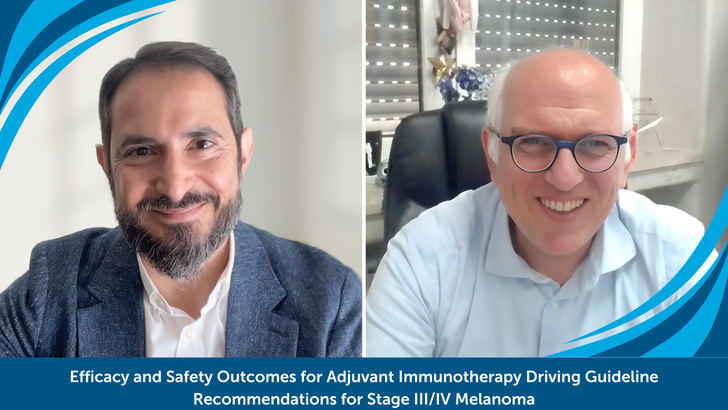
Hello, this is CME on ReachMD, and I'm Dr. Hussein Tawbi. With me today, my good friend and colleague, Dr. Paolo Ascierto.
Dr. Ascierto, what efficacy and safety outcomes for adjuvant immunotherapy are driving today's guidelines and recommendations for how to manage patients with stage III or IV melanoma?
Dr. Ascierto:
So good morning, Hussein. It's a pleasure to be here with you. So you want to know the data about 3 important clinical trials in the field of immunotherapy in adjuvant. So the CheckMate 238, the KEYNOTE-054, and the IMMUNED.
CheckMate 238 is an interesting trial which compared nivolumab dosage of 3 mg/kg for 1 year, compared, not to placebo, to active ipilimumab 3 mg/kg with the 4 doses induction, and then every 3 months still for a total of 1 year. Relapse-free survival, distant metastasis-free survival, and progression-free survival, too, now we have data at 7.5 years, were in favor of nivolumab. Overall survival was exactly the same, but what we can say? So the comparison was between 2 active arms; the experimental arm and the ipilimumab arm, which we know was better than placebo.
And a lot of patients, when progressed from IPI, were treated with IPI/NIVO. So, probably, it's something expected. But what is important is that, at 7.5 years, the 70% of patients were still alive. This is better compared to the historical control.
KEYNOTE-054. Pembrolizumab 1 year, 200 mg every 3 weeks, versus placebo in an EORTC trial. And again, relapse-free survival and distant metastasis-free survival were superior compared in the experimental arm. Pembro, in this case, compared to placebo. We are still waiting for overall survival data, but in the meantime, it was approved.
IMMUNED, a German trial. Interesting trial, because was for the stage IV. What I missed to say for the other 2 trials, that while the ChechMate 238 was for the stage IIIB/C and IV resected, the KEYNOTE-054 was for all stage III—IIIA, IIIB, IIIC—no stage IV. IMMUNED, only for the stage IV resected, with no evidence of disease.
So the trial compared high-dose ipilimumab plus nivolumab versus nivolumab and also the control arm. And it was a small trial, randomized phase 2. But was really impressive. The advantage of IPI/NIVO compared to nivolumab in these patients. And one difference between IMMUNED and the CheckMate 915 was that here, the dosage of IPI/NIVO was 3 mg/kg. From my point of view, this made the difference.
So I tried to give you another view about the data, and of course, now I would like to know from you what you think about the impact on the guidelines.
Dr. Tawbi:
Yeah, it's really interesting because I do agree with you. It's so important that relapse-free survival matters to patients, and trying to prevent relapse is very important. While we're not seeing yet an overall survival benefit, I think a lot of patients will be served by being treated with active immunotherapy to prevent the recurrence.
The other component, Paolo, as you mentioned, that we don't use combination immunotherapy in the adjuvant setting. And we already have seen 2 clinical trials actually show negative results with the addition of TIGIT and with the addition of LAG-3 to PD-1. The only place where we see that combination actually gives you additional benefit is the high-dose combination in resected stage IV, just with the IMMUNED trial. And I have to say, that IMMUNED trial affected my practice immediately. I remember coming back from ESMO right after it was presented, and the same week, I had a patient with the same situation. I immediately applied it in my practice. So I think it's a situation where we have plenty of evidence that adjuvant therapy is effective for high-risk resected melanoma, and only for those that have metastatic resected disease, I would consider combination immunotherapy.
With that, our time is up and thank you so much for listening.
Announcer:
You have been listening to CE on ReachMD. This activity is provided by Prova education and the National Comprehensive Cancer Networkand is part of our MinuteCE curriculum.
To receive your free CE credit, or to download this activity, go to ReachMD.com/Prova. Thank you for listening.