
Transcript
Announcer:
Welcome to CE on ReachMD. This activity is provided by Global Learning Collaborativeand is part of our MinuteCE curriculum.
Prior to beginning the activity, please be sure to review the faculty and commercial support disclosure statements as well as the learning objectives.
Dr. Levy:
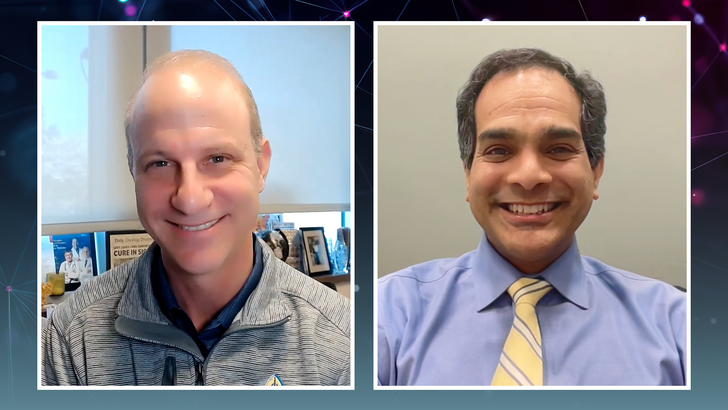
This is CE on ReachMD, and I'm Dr. Benjamin Levy.
Dr. Khandekar:
I'm Dr. Melin Khandekar.
Dr. Levy:
Great to have you, Melin. Melin, let's start with a case to frame our discussion. This is a 64-year-old never-smoker who presents to her primary care physician with a cough and some 10-pound unintentional weight loss. Unfortunately, the workup of this reveals a right upper lobe mass as well as bone metastases and liver mets. Her brain MRI is negative. The biopsy is done and reveals an EGFR sensitizing mutation, and the decision, based on this, is to start both osimertinib plus chemotherapy à la the FLAURA2 regimen.
This patient does quite well on this regimen but unfortunately develops progression not only in the lungs and liver but also develops new brain mets.
So, Melin, very common scenario here. How do you approach this case? And we'll talk about next line of therapy here potentially being datopotamab deruxtecan, which is where this is approved. But you've got that patient in your office who's had progression intracranially, no brain mets at the beginning. How do you walk this decision-making with your patient?
Dr. Khandekar:
Thanks, Ben. I think this is a question that unfortunately comes up a lot, and we always try to think about how do we maximize the overall benefits of our therapies and minimize the harm? And do we need to add multiple therapies, or can we choose one therapy that will have activity in both areas? And some of this, I think, is colored by what symptoms are the patient having.
So it's something where we talk to the medical oncology team, we talk to our neurologists, neurosurgeons, and kind of come up with a joint plan.
But maybe, Ben, you could review the clinical data of the activity of antibody-drug conjugates in EGFR-mutated metastatic non-small cell lung cancer, and that kind of gives us the baseline kind of for the data that we need input from a local therapy perspective to inform choices.
Dr. Levy:
And front and center for ADCs in EGFR-mutant lung cancer is datopotamab deruxtecan. This is a TROP2 ADC that has been looked at extensively in lung cancer and really has panned out in the EGFR space. And the data that we've got with datopotamab deruxtecan in the EGFR lung cancer space is from a pooled analysis from studies called TL05 and TL01.
The bottom line here is they pooled patients from 2 different studies that were EGFR positive that had received single-agent datopotamab deruxtecan, and there were roughly 117 patients that were evaluated. And in the pooled analysis, the response rates for single-agent Dato-DXd in patients that were EGFR positive who had had disease progression on a TKI and chemotherapy, the response rates were north of 40%. The PFS was around 6 months, and the OS was north of a year; it was 15 months. And so because of this pooled analysis data, datopotamab deruxtecan is approved for patients that harbor EGFR sensitizing mutations that have had disease progression on a third-generation TKI and chemotherapy.
There's another new kid on the block, an emerging ADC, called sacituzumab tirumotecan. It is yet another TROP2 ADC that is being looked at in the EGFR space. And there's really 2 studies to mention. One is the OptiTROP-Lung03, which was looking at this compound versus docetaxel in the third line for patients with advanced adenocarcinoma of the lung that were EGFR mutated, and that showed improvements in PFS and trends towards OS.
And then more recently the OptiTROP-Lung04 looking at sac-TMT versus chemotherapy in the second line for patients that are EGFR positive who have disease progression on a third-generation TKI. And once again, very interesting trends here, improvements in PFS, we're seeing improvements or trends in OS. This has got a priority review at the FDA, so we'll have to see how sac-TMT comes into the fold and how it’s leveraged versus how we use datopotamab deruxtecan. So a lot there.
But certainly as, Melin, you mentioned, we've got to talk to each other about how you would approach this versus us letting you know that there may be CNS penetration here with these agents and really kind of flesh this out.
Dr. Khandekar:
Yeah, I think that's a great point. And we've been also very excited to see for many ADCs that we're seeing intracranial responses, with the caution there that we need data to know a little bit more about who's likely to respond.
If we can minimize toxicity by only using one therapy that they need for both [intracranial and extracranial] sites, that's the best option. But we're also ready to stand in and step in with radiation as needed.
Dr. Levy:
Yeah, let's reverse and go back to the case and yet another discussion between medical oncology and radiation oncology. If this patient had baseline brain mets—now, remember in the case that I presented there were no baseline brain mets—but an EGFR-positive patient with baseline brain mets. Are there still opportunities to do radiation up front for these EGFR-positive patients? Are there still scenarios where you would do that?
Dr. Khandekar:
It’s a great question. And as you said, this is a prime example of where we've seen total change in how these patients are managed for the benefit of toxicity for people, in that we feel very comfortable in starting with EGFR-directed TKIs, for example. We have a lot of data.
I think the question that we have is many of these people will still need radiation at some point. And what is the optimal time to intervene with radiation?
Dr. Levy, what would you do if this patient had received first-line amivantamab lazertinib?
Dr. Levy
I think that if the patient had received this MARIPOSA regimen of amivantamab and lazertinib, clearly we would probably want to give chemotherapy first. And in that case, if there was CNS progression at the same time, I would certainly lean on my radiation oncologist because chemotherapy, as we know Melin, doesn't really penetrate the brain all that well and so that would be an opportunity where I would want to work with the radiation oncologist.
Let's rewind again. What if this patient had prior stereotactic radiosurgery? This comes up a lot; you mentioned it earlier with ADCs. What do you need to know about the risk of radiation necrosis?
Dr. Khandekar:
It's a difficult question and we are seeing it in patients because people are doing better on systemic therapies, living longer. But what we know about radiation necrosis is that this is a late effect that we can see after radiosurgery to the brain. There are reports of that being increased in people getting ADCs, although it's not clear is this a class effect across all ADCs. Does it depend on the target or the payload that's delivered?
I would say the other big area of interest is how do we diagnose it? Because often this is a question that comes up. Is this treatment progression or radiation effect? Is this necrosis or disease? And how do we determine this? And people have looked at a lot of different imaging modalities. Unfortunately, there's no one modality that tells us for sure, and often it's the test of time and clinical behavior, although we're looking at newer modalities to try to assess this, but this is still an ongoing work for which we need better diagnostic tools.
Dr. Levy, how would you approach second-line therapy if the treatment goal is rapid systemic control versus intracranial control?
Dr. Levy:
This is such a tough question, and this is what we've been talking about. How do you prioritize the cancer below the neck and in the brain? And this is where I have conversations with radiation oncologists all the time. What do we do here?
If I feel like we need to get more control of what's going on in the liver and the lungs, that's clearly an opportunity to leverage in an ADC, a TROP2 ADC like datopotamab deruxtecan, with the hope is there may be some penetrance into the brain. However, the CNS takes priority for me. I mean, if the patient has uncontrolled CNS disease, no matter what's going on below the neck in the lungs and the liver, I'm really relying on radiation approaches here to help control what's going on in the brain. That takes precedent.
Dr. Khandekar:
I totally would agree with that, that it's a discussion, and we rely on that open communication to try to maximize the benefit for the patient. And in these difficult scenarios, everyone's different, every patient is different, and we just try to have a discussion.
Dr. Levy:
Well, that's all the time we have today. We hope you found this case discussion helpful, and thanks for listening.
Announcer:
You have been listening to CE on ReachMD. This activity is provided by Global Learning Collaborative and is part of our MinuteCE curriculum.
To receive your free CE credit, or to download this activity, go to ReachMD.com/CME. Thank you for listening.
 In support of improving patient care, Global Learning Collaborative (GLC) is jointly accredited by the Accreditation Council for Continuing Medical Education (ACCME), the Accreditation Council for Pharmacy Education (ACPE), and the American Nurses Credentialing Center (ANCC) to provide continuing education for the healthcare team.
  This activity has been accredited by the European Board for Accreditation of Continuing Education for Health Professionals (EBAC®).
  Global Learning Collaborative (GLC) designates this activity for 1.0 contact hour(s)/0.1 CEUs of pharmacy contact hour(s).
  Global Learning Collaborative (GLC) has been authorized by the American Academy of PAs (AAPA) to award AAPA Category 1 CME credit(s) for activities planned in accordance with AAPA CME Criteria. This activity is designated for 1.0 AAPA Category 1 CME credit(s). Approval is valid until 05/07/2027. PAs should claim only the credit commensurate with the extent of their participation in the activity.