
Transcript
Announcer:
Welcome to CE on ReachMD. This activity is provided by Prova education and the National Comprehensive Cancer Network. This episode is part of our MinuteCE curriculum.
Prior to beginning the activity, please be sure to review the faculty and commercial support disclosure statements as well as the learning objectives.
Dr. Tawbi:
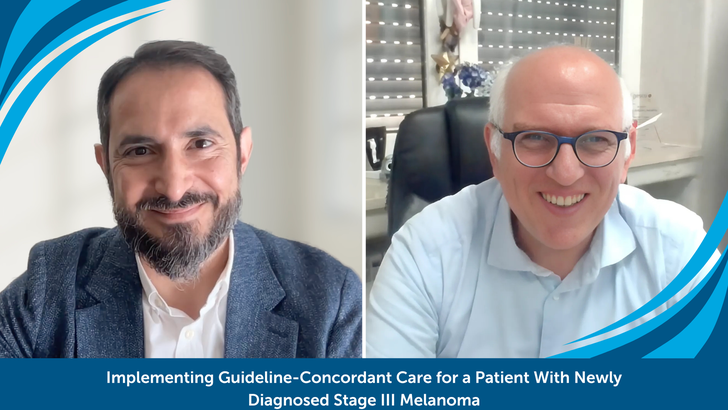
This is CME on ReachMD, and I'm Dr. Hussein Tawbi. With me today, my good friend and colleague, Dr. Paolo Ascierto.
And Paolo, I have an interesting situation to discuss with you. Just about a month and a half ago, I had a patient who's been previously healthy in his early 50s, an engineer, who noted an axillary mass. And it was relatively large. It was about 6 cm, palpable, mobile, nontender, and came to my practice. Of course, we biopsied this. It was metastatic melanoma. He had no known primary and when we did a PET scan and MRI of the brain, he had no evidence of distant disease. So how would you manage a patient with that situation in your practice.
Dr. Ascierto:
Thank you for this question, Hussein. It's an important question, mainly because now we have important data in the field of neoadjuvant, in mainly in adjuvant with immunotherapy, where there is an advantage in terms of mechanism of action with a better immunization of the patients.
We have 2 clinical trials now, the SWOG 1801, and the NADINA trial. So 2 different approaches; one with monotherapy, the other one with combination. With the combination, I believe that you have an advantage. We know this from some preliminary studies. We’re looking to the pathological complete response. The number of pathologic complete response was higher in the combination with IPI/NIVO, more than with the single-agent anti-PD-1. So in general, this is what they prefer. Even for another important reason. Because these are data from the NADINA. If we get complete response, or major pathological response, it’s better to say even in the patients with a near pathological response, we can start the treatment after the surgery because we know now that these are the group of patients that can respond without any adjuvant. And with data from the NADINA, this is not a few patients. This is the 60% of the patients. So I believe that this will be really important.
Of course, for all the patients where the combination is probably not so appropriate, so maybe elderly patients, so in general, I would say the patients who don't fit for the combination, surely, for these patients, the treatment for how the SWOG-1801 with pembro 3 weeks, treated 3 cycles, surgery, then, adjuvant pembro, it’s another important option. I believe that this approach is the approach that should be taken into consideration for all the patients with resectable disease, because this is the group of patients that can get a benefit from these patients. Many patients, of course, with lymph node disease.
In the future, probably, we can have also some even an interesting approach. This is more for the patients than for clinician, with the use of subcutaneous nivolumab. Still, something that can help for the patients, mainly for the adjuvant. We'll see. But the neoadjuvant approach with immunotherapy, it's an important now schedule, and it’s a must that we should consider in our clinical practice.
Dr. Tawbi:
Yeah, thank you, Paolo. It's really impressive. I mean, we have randomized evidence now of how much superior neoadjuvant therapy is. And I completely agree with you. The combination induces a higher response rate, both pathologic complete response and a major pathologic response.
I have to tell you, the other regimen that's out there is nivolumab and relatlimab, and we had ran a 30-patient trial between MD Anderson and Memorial Sloan Kettering, and showed that the pathologic complete response was actually almost the same, if not a little higher than low-dose IPI/NIVO. So for my patient, I chose to do that. I gave him 2 cycles of neoadjuvant nivolumab/relatlimab. When he showed up for his second dose, he was already experiencing a response, which was really nice to see. But in that context, that combination is now in the NCCN Guidelines, but we still need a randomized larger trial for that combination.
And I really think that those patients benefit long term. To your point, the idea of being able to potentially eliminate the need for adjuvant therapy in those patients that do really well.
So, well, thank you so much, Paolo. This was a really great discussion. And our time is up, so hopefully, you found this brief case review useful for you. And thank you so much for listening.
Announcer:
You have been listening to CE on ReachMD. This activity is provided by Prova education and the National Comprehensive Cancer Networkand is part of our MinuteCE curriculum.
To receive your free CE credit, or to download this activity, go to ReachMD.com/Prova. Thank you for listening.