
Transcript
Announcer:
You have been listening to CE on ReachMD. This activity is provided by Prova education and the National Comprehensive Cancer Networkand is part of our MinuteCE curriculum.
To receive your free CE credit, or to download this activity, go to ReachMD.com/Prova. Thank you for listening.
Dr. Tawbi:
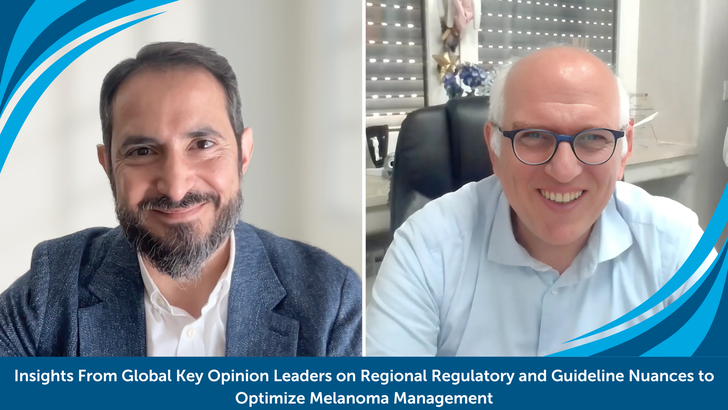
Hello, this is CME on ReachMD, and I'm Dr. Hussein Tawbi. I'm joined today by my good friend and colleague, Dr. Paolo Ascierto, who practices in Italy. And in this session, it's really important for us to talk about how the regulatory and guideline nuances around the globe affect melanoma management.
So, Paolo, what insights can you share from a European perspective?
Dr. Ascierto:
So, thank you, Hussein, for this important question for me as European, and would be more important, as Italian. And I will explain the why of this is my answer.
So, in Europe, a treatment is really linked to the approval from the EMA regulatory agency. And so there is a very strict connection. What does it mean?
You mentioned in the episode 5, that suggests to all the attendants to look, that in your practice, you can use nivolumab/relatlimab as a neoadjuvant. We cannot do this here. As far as in Europe, this combination was approved only for the PD-L1 negative. This was something that, as a melanoma doctor, we really don’t like. But this is the labeled movement in Europe. But if you want to treat a PD-L1-positive patient, or to use this combination as neoadjuvant, you cannot.
In Italy, we have restriction even for the combination of IPI/NIVO and nivolumab, because it's given only for the PD-L1 negative, still according to some subgroup analysis in CheckMate 067.
So this is what happened. You cannot get reimbursement, it is better to say, for all the off-label indications. And even the guideline for ESMO, we should consider really what was approved by AMA, what’s not. So we cannot do treatment off label.
This is different from US because when you have the approval, then you can use also in other indications if you have, of course, some signal of activity. I remember the pembrolizumab plus lenvatinib, the data from the LEAP-004, and NCCN put this combination in as possible treatment in the drive. This is something that we cannot do. So this may have an advantage in terms of cost, but it's also disadvantageous for patients because we have less options.
So what do you think about this?
Dr. Tawbi:
Yeah. No, it's a really interesting situation because even in the US, we have FDA approvals, and the FDA can approve a regimen for a certain indication. But then, the NCCN Guidelines are written by melanoma experts—surgeons, dermatologists and medical oncologists—that really contextualize the result and look at data from smaller trials and see if those combinations that are now FDA-approved can be used in certain settings based on the emerging data. So that's what allows us sometimes to – again, NIVO/RELA is not approved in the neoadjuvant setting in the United States, but because there is data that it's relatively safe and has efficacy, the NCCN considered that to be a regimen that's available to us.
The PD-L1 positive versus PD-L1 negative was a very mystifying kind of decision from the European authorities because it was based on subgroup analyses from RELATIVITY-047. So hopefully, that over time, as data accumulates, you'll be able to widen the reach of that combination for your patients. But at the end, we have to follow guidelines and only use what's FDA-approved, or EMA-approved in your case. And the idea is we want to just offer our patients the best possible treatment with the highest response and the lowest toxicity.
I tell my patients, I'm greedy. I want them to get cured with the lowest toxicity possible. And we should continue trying.
But thank you so much for sharing those challenges that you face on the European side, and thank you so much for a great discussion. Our time is up and thank you, everyone, for listening.
Announcer:
You have been listening to CE on ReachMD. This activity is provided by Prova education and the National Comprehensive Cancer Networkand is part of our MinuteCE curriculum.
To receive your free CE credit, or to download this activity, go to ReachMD.com/Prova. Thank you for listening.