
Transcript
Announcer:
Welcome to CE on ReachMD. This activity is provided by Prova Education and is part of our MinuteCE curriculum.
Prior to beginning the activity, please be sure to review the faculty and commercial support disclosure statements as well as the learning objectives.
Dr. Paz-Ares:
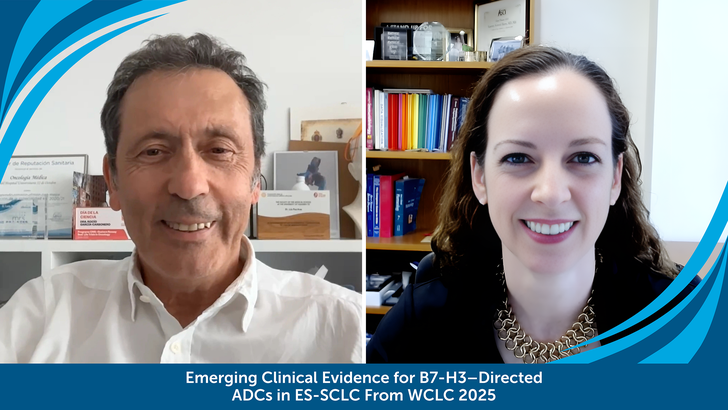
This is CE on ReachMD, and I am Luis Paz-Ares.
Dr. Byers:
And I'm Lauren Byers.
Dr. Paz-Ares:
Lauren, we just attended the World Lung Cancer Congress 2025 in Barcelona. Andwould you review for us the latest clinical data that were presented on B7-H3–directed ADCs?
Dr. Byers:
Absolutely. SoI think there was a lot of excitement aroundsome of the updated data and some of the new data coming out for B7-H3 antibody-drug conjugate targeting. And so there was actually asession that was devoted specifically to these antibody-drug conjugates, and 2that were really highlighted included the I-DXdstudy, as well asanother therapeutic also targeting B7-H3, which isQLC5508.
And I think just to kind of give a broad overview, what we're seeing with these B7-H3 antibody-drug conjugatesis that they'redemonstrating a strong signal of response, and also patientsare havingvery rapid responses to these.
So for example,in the updateddata that was presented from the I-DXd trial—this isagain targeting B7-H3using a Topo-1payload—the response ratesoverall were around50%, and the duration of responseforthe datathat’s availableto date was around 5.3 months, with a PFS of around 5 months. And I think something that was especially encouraging was the median overall survivalof around 10 months for these patients, whoare relapsed patients with small cell lung cancer.
With the secondB7-H3 ADC, the QLC5508 which was presented by Dr. Zhou,this also showed a similarly encouraginglevel of activity, with a median progression-free survival of 6 months and a median overall survival around a yearagain, which isvery exciting to see that level ofdurability.
And just in general, some of the common toxicities include hematologic toxicities with the Topo-1 payload, which again is not unexpected but generally was well tolerated. So there are now phase 3 trials proceeding to see if these could become new standards of care.
Dr. Paz-Ares:
This is really good news, having the updateddata from those 2trials. And I think today there are at least5of these ADCs directed to B7-H3 that have presented data.
I must say that,for most of the cases, the data are pretty similar oneto each other in terms of efficacy. As you said responses around 50%, median PFS 5 to 6 months, and median OS 10 to 11 months.
SoI know it is not clear to me, apart from some slight difference in toxicity, particularly pneumonitis, that it is not going to be really easyto make a clear difference.
On the other hand, it is unclear today what is the role of biomarkers in this setting. It looks like expression is nota greatpredictor. Andwe didn't see—I mean, at least I'm not aware about—any biomarker related to the payload.What do you think about how thefield will move in those respects, in terms of predictors?
Dr. Byers:
Yeah. SoI think those are really great points. We see that across the small cell lung cancer subtypes, for example, thatB7-H3 is consistently expressed at relatively high levels, and so it is a verycommon and consistently expressed target.
I agree that thinking about the payload will be important. Many of these antibody-drug conjugates for a variety of targets are usingsimilarpayloads, and I think we expect that we will see mechanisms of resistance similar to what we've seen to some extent withprior chemotherapy studies. And understanding that better and sort of how we cananticipate what might be the mechanisms of resistance or ways to combine these antibody-drug conjugates targeting B7-H3 with other agents, I think, will be things going forward that will be really interesting to think about and to seehow thosemight be combined.
Dr. Paz-Ares:
Absolutely. Okay, so I think it's been a greatmicro discussion, I could say. But our time is up right now. So thank you very much for this conversation and thank you very much for listening.
Announcer:
You have been listening to CE on ReachMD. This activity is provided by Prova Education and is part of our MinuteCE curriculum.
To receive your free CE credit, or to download this activity, go to ReachMD.com/CME. Thank you for listening.
 In support of improving patient care, Global Learning Collaborative (GLC) is jointly accredited by the Accreditation Council for Continuing Medical Education (ACCME), the Accreditation Council for Pharmacy Education (ACPE), and the American Nurses Credentialing Center (ANCC) to provide continuing education for the healthcare team.
  Global Learning Collaborative (GLC) designates this activity for
  Global Learning Collaborative (GLC) has been authorized by the American Academy of PAs (AAPA) to award AAPA Category 1 CME credit(s) for activities planned in accordance with AAPA CME Criteria. This activity is designated for 0.50 AAPA Category 1 CME credit(s). Approval is valid until