Transcript
Announcer:
Welcome to CE on ReachMD. This activity, titled “Improving Quality Care Across the Spectrum of HER2 Expression in HR+ Metastatic Breast Cancers: Practice Changes to Improve Care” is provided by AXIS.
Prior to beginning the activity, please be sure to review the faculty and commercial support disclosure statements as well as the learning objectives.
Dr. Kim:
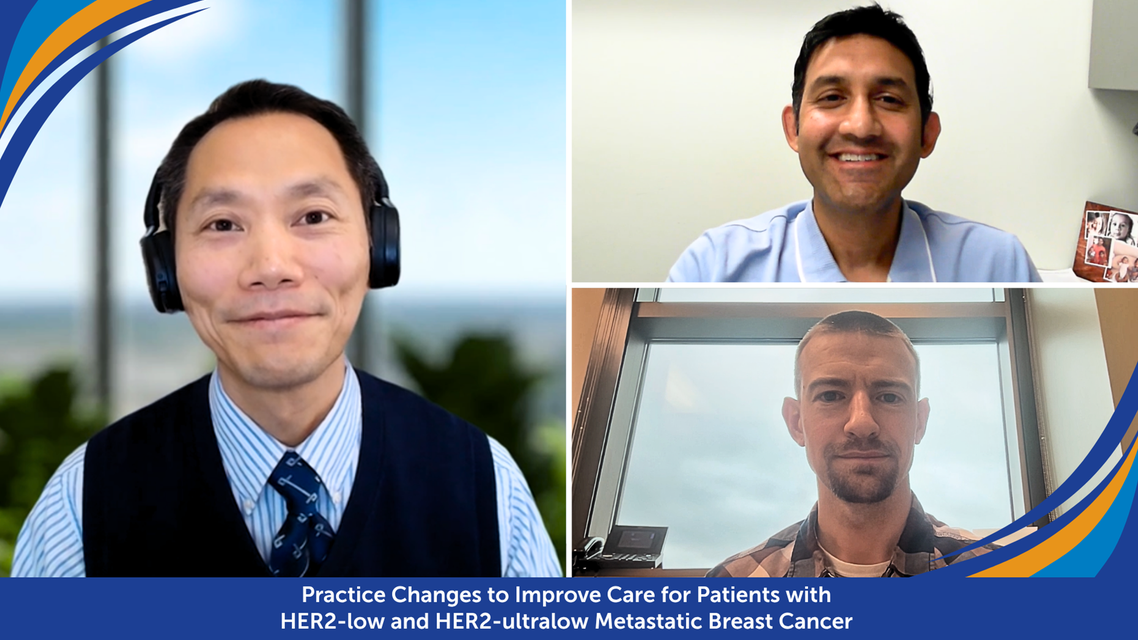
Welcome to this continuing education activity titled Practice Changes to Improve Care for Patients With HER2-Low and HER2-Ultralow Metastatic Breast Cancer. My name is Joe Kim, President of Q Synthesis, and I will be the moderator for this program.
Today, I'm joined by Dr. Dalia as well as Dr. Jurief.
Dr. Dalia:
Thanks, Dr. Kim. I'm a medical oncologist here at Mercy in Joplin, and I help lead our initiatives for quality assurance with our cancer center.
Dr. Jurief:
I'm Dr. Jurief. I'm an anatomic and clinical pathologist here at Mercy Joplin and predominantly diagnosing tissue cancer in surgical pathology.
Dr. Kim:
So today, we are going to be talking about a quality improvement program that Mercy underwent, and we're going to discuss some of the common barriers that can limit the identification of patients with both HER2-low as well as HER2-ultralow metastatic breast cancer and explain how pathology reporting templates and formatting changes can improve clarity, as well as the usability of that HER2 IHC result to support interprofessional treatment plan coordination.
To set the stage, I think it's helpful to just think about the journey that we've taken, where in the earlier 2000s HER2 classification in breast cancer was predominantly positive or negative, and then in 2022 the DESTINY-Breast04 study led to the indication of T-DXd in HER2-low metastatic breast cancer, defined as IHC 1+ or IHC 2+ ISH-negative. And then more recently, in 2025 DESTINY-Breast06 with T-DXd in both HER2-low, as well as now HER2-ultralow, defined as an IHC 0 with some staining, also referred to as IHC 0+, which also led to an FDA approval.
So a lot has changed just within the last couple of years, and we're eager to talk about how this change has impacted both treatment planning but also care coordination and communication across the treatment team.
So let's begin with the need for change. Why was change needed? And what were some of the key challenges and barriers that were happening because of all the recent data, as well as these new FDA approvals?
And Dr. Dalia, let's start with you.
Dr. Dalia:
Yeah. So just looking back at 2024, 2025, and even going back to 2022, once these DESTINY-Breast trials started to result, we were more in tune to looking at patients who had low HER2 status. And by 2022, we were asking our pathologists, hey, can we please make sure that we're reporting out 1+ or 2+ on the IHC if it wasn't on a path report for some reason, and they were FISH-negative or ISH-negative? And we were saying this is needed in the metastatic setting for T-DXd.
Move forward to 2024-2025, and the new DESTINY-Breast trials showed us that we now need to look for HER2-low and -ultralow patients as well, or this 0+, as we say, from IHC staining, so that we could provide some of our metastatic patients with the T-DXd if it was the appropriate treatment.
So the paradigm that came in our clinic was more so how do we make sure that everybody is on the same page to test this way and to make sure that we are getting all of this information in an easy way to look at this, both at our local institution and because we're a health system, all across our health system.
Dr. Kim:
Thanks so much for starting us off. And Dr. Jurief, as a pathologist, what were the issues, as well as the discussions that were happening within the pathology groups, just given some of the changes, as well as some of the challenges related to HER2 scoring and interpretation?
Dr. Jurief:
Yeah, most of it involved making sure that the other pathologist here and I had sort of similar communication with the oncologist, that our reports would read the same when it came to ultralow or 0+ staining. And then too, making sure that between interobserver variability, we were essentially on the same page. So for the first few cases that we thought qualified for ultralow, we would show them to one another and make sure that we both agreed, so that we sort of had the same standard between each other.
And then too, looking at what was our HER2 negative control on our IHC to make sure we understood what a real 0 was, and make sure that with our stain, IHC stain for HER2, that there wasn't any background staining when it should be a true 0−. And then making sure that moving forward that our reports were clear for the treatment team.
Dr. Kim:
Great. Thank you.
So Dr. Dalia, curious to hear, as you explored what was going on within medical oncology, did you find either some common themes or some differences as to what was happening across different Mercy locations, whether it's within the state or even other locations, in terms of like how they were actually identifying patients, as well as their awareness and their knowledge around some of these new changes?
Dr. Dalia:
So we at Mercy, we have institutions mainly in 4 different states that do oncology, so Missouri, Kansas, Arkansas, and Oklahoma. And when we surveyed our medical oncology teams and our pathology teams across Mercy, we did learn that some of our teams were already reporting HER2-ultralow out and kind of had it in a format where their medical oncologist could read it, and some of them were not.
And one of the questions that came up is the CAP guidelines at that time in 2024 were not updated yet to introduce this IHC 0+, so a lot of our sites were waiting until that occurred. So we had to have discussions with both our medical oncology teams and our pathology teams to try to have them better understand the rationale for why this was needed earlier than the CAP guidelines changing so that we could get that information to the medical oncology teams, which could impact patient care.
Dr. Kim:
Great. Thank you.
So as part of this program, we looked at some data regarding how patients were either being identified, how they were being classified, and then ultimately the kind of treatments that they were receiving. And one of the interventions for this program involves some continuing education for members of the cancer care team. So we had education reviewing some of the DESTINY-Breast04 as well as 06 studies, as well as some of the results from it. But then, on a practical level, a lot of discussions as to what does this now mean for either each cancer center location, as well as what does this mean for the health system as a whole.
So Dr. Dalia, what were some of the initial sort of responses, feedback, as well as discussions that resulted from the actual educational intervention and some of the follow-on conversations that occurred afterwards?
Dr. Dalia:
After we had this educational session here locally in Joplin, I think our local teams here, both our pathology teams and our medical oncology teams, all agreed that based on the DESTINY-04 breast studies and the DESTINY-06 breast studies, that we needed to report out the IHC 0+, and we needed to report out the HER2-low patients. And we all came to a consensus that in the pathology reports it should be written as IHC 0+ HER2 ultralow, and then IHC 1+ should be reported out as HER2-low, just to make it easier for the oncologist to kind of realize that this is something that fits the criteria of the trial.
So once we kind of had that established at our local institution, we went to all of Mercy and suggested to all of our other groups that, hey, this is how it should be reported out, and most of them ended up changing to this reporting as well.
Dr. Kim:
Dr. Jurief, what were some of the initial reactions, as well as conversations across pathology, the different pathologists, how did they respond?
Dr. Jurief:
Yeah, fortunately, there's only 2 pathologists here, myself and 1 other pathologist, so it was pretty easy to communicate amongst each other that we agreed if there was any treatment benefit, if it was helpful at all for the treatment team to report out ultralow from here on out, then we agreed that we would do that. We would change the reports as necessary going forward.
Dr. Kim:
And then once the C-A-P, the CAP reporting biomarker template came out and you now had this option of reporting there's a 0 versus a 0+, how long did it take before the electronic health record and the reporting templates within the system were either adopted or changed to be able to sort of accommodate that kind of 0+ reporting? Dr. Jurief?
Dr. Jurief:
Yeah, the interesting thing is I've reached out to some people about changing some of the built-in templates in our EMR. Some of the templates do reflect the 0+ as an option, and some of them don't, so I've asked them to look into the ones that do not, but I've not yet had a response. But it would be easier, it would make the reports a lot cleaner if those templates did show the new CAP reporting.
Dr. Kim:
So it sounds like a big part of this is certainly going to depend on the kind of communication between pathology as well as medical oncology.
So Dr. Dalia, are you finding that medical oncologists are asking pathologists in some cases to either go back and relook at a slide or to perform like retesting in cases? Like, what are some of the trends and the kind of communication that's happening across the team there?
Dr. Dalia:
Yeah, and we’re in a center where we communicate with our pathologists all the time about cases, so we're very comfortable talking to our pathologists. But I have noticed that our medical oncologists have been asking the pathologists more so, even on older cases from 5, 6, 7 years ago that are now unfortunately metastatic, hey, this is a HER2 0, can you look at it again to see if it's HER2-ultralow? And those conversations are happening frequently now. And I know across our health system the same thing is happening based on this new clinical information that can impact patients.
Dr. Kim:
Thank you. It was interesting in the DESTINY-Breast06 study how 64% of tumors that were initially reported locally as like an IHC 0, when they were then re-reviewed under central review, 60% of them were ultimately reclassified.
So are you finding, Dr. Jurief, across just in terms of the challenge of like having other people look at a slide and either the concordance versus the discordance, like what have you found when it comes to looking at these lower levels of HER2 expression by IHC?
Dr. Jurief:
There does seem to be some interobserver variability, but I mean that's with any case. I mean, if you're talking about, well, if it were 11%, we would call it 1+, but to me it looks more like 8%, that's a difficult thing to draw a line through. But there will be some, I'm sure, discordance with interobserver variability, but it doesn't seem to be that there's any more now that we're reporting out 0+ as other institutions start to adopt 0+ as well.
Dr. Kim:
It seems like we continue to see sort of this evolving landscape of potentially more patients being eligible for this treatment, so it's going to be the future, I guess, in terms of like how many patients ultimately are deemed eligible, as well as just seeing more patients receiving treatment. It's going to be important to make sure that close monitoring, and all those other patient safety factors, are incorporated into those treatment plans.
I want to get your thoughts on this paper that recently was published in Modern Pathology. It was an international expert consensus recommendation. It sounds like it really reflects and summarizes what you all have already incorporated at Mercy, but just any thoughts or reflections on how they've sort of differentiated the IHC score along with this clinical category, knowing that this nomenclature of HER2-ultralow or HER2-low, it's not quite in the guidelines yet, but yet at the same time it's clinically really important? Dr. Dalia, any reflections or thoughts on what you see here?
Dr. Dalia:
My reflections with this is this is how the clinical categories, I think, is a great addition that this paper brought, because I think this is how we think about it in the clinic. We're saying is the patient HER2-ultralow? Are they HER2-low? Or are they HER2-positive? We're not always necessarily saying is their IHC score 0+? That's kind of what we're thinking in our head when we're looking at these things. But I think reporting it out as HER2-ultralow with a score of 0+ makes it easier for clinicians to look at that and say okay, there is a targeted drug available for this.
Dr. Jurief:
Yeah, I mean just again emphasizing clear communication that not only would other pathologists understand, but the clinical team would understand. So in our reports, we try to include both the terminology from the IHC score standpoint, but then also the clinical category. So in our reports, it'll say HER2-ultralow and then in parentheses 0+, so that there's no confusion at all. So it's very straightforward for everybody looking at the report.
Dr. Kim:
Thank you. So as we get ready to wrap up, how would you sort of summarize some of the key lessons learned, as well as key takeaways perhaps that other cancer centers may want to incorporate based on this project, as well as just reflections on how care has improved as you all have worked on improving both reporting but also communication? Dr. Dalia, let's start with you.
Dr. Dalia:
Okay, so I think that the main thing that we've learned from doing this project and making this better for our patients is that you have to have really good communication between your medical oncology team and your pathology team to try to figure out what is the best way that you can use pathology reports and information to help make sure that you're taking care of patients on the cutting edge of oncology care.
And since oncology is changing at all times, I think it's really important for us to have these conversations that are ongoing, and we meet with our pathology group regularly to discuss, hey, what can we do to make things better for our patients here? And I think that's the most important takeaway is if you're in good communication with your pathology team, you're going to be able to make these changes quickly, and they're going to impact patients quicker than waiting.
And then the second thing that I think is important is, is that it depends how that information is translated in your electronic medical record. So this is where I like that paper that we were just discussing, where instead of it saying IHC 0+, which somebody, if they're glancing over a pathology report may miss, that means that this is HER2-ultralow, but also having that text that says HER2-ultralow in the chart is very helpful for us to remember, hey, T-DXd may be an option for patients.
Dr. Kim:
Thank you.
Dr. Jurief, what would you say are some of the lessons learned and reflections for other cancer centers based on this work, as well as the changing landscape of HER2 in breast cancer?
Dr. Jurief:
Yeah, I just have to echo again what Dr. Dalia said about good communication between the oncologists and the pathologists and clear reporting, and then to standardization between interobservers and making sure there's a standardized way of reporting the information from the pathologist to the treatment team. And then again, looking and making sure that you understand how your IHC operates in the landscape of this spectrum of 0, true negative, to true positive, 3+.
Dr. Kim:
Well, thank you so much to both of you for your reflections, as well as for joining us along this journey of improving care in patients with HER2-low as well as HER2-ultralow metastatic breast cancer. And this now concludes our program.
Announcer:
You have been listening to CE on ReachMD. This activity is provided by AXIS.
To receive your free CE credit, or to download this activity, go to ReachMD.com/CME. Thank you for listening.
 In support of improving patient care, AXIS Medical Education is jointly accredited by the Accreditation Council for Continuing Medical Education (ACCME), the Accreditation Council for Pharmacy Education (ACPE), and the American Nurses Credentialing Center (ANCC), to provide continuing education for the healthcare team.
  This activity was planned by and for the healthcare team, and learners will receive 0.25 Interprofessional Continuing Education (IPCE) credit(s) for learning and change.