
Transcript
Announcer:
Welcome to CE on ReachMD. This activity is provided by Prova Education and is part of our MinuteCE curriculum.
Prior to beginning the activity, please be sure to review the faculty and commercial support disclosure statements as well as the learning objectives.
Dr. Byers:
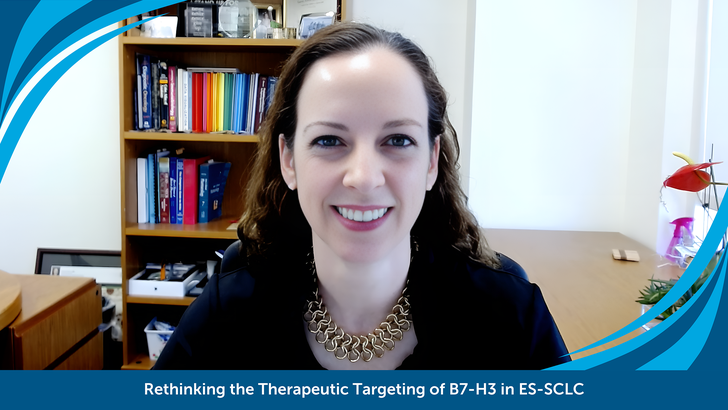
This is CE on ReachMD, and I'm Dr. Lauren Byers. Today,I'll provide a brief overview of the rationale for targeting B7-H3 in extensive-stage small cell lung cancer.
So to start with, what is B7-H3? B7-H3 is a transmembrane protein which is overexpressed in a variety of cancers, including lung cancer, prostate, and esophageal cancers, and B7-H3 expression has been associated with poor prognosis.
A finding from our group and colleagues is that B7-H3 is consistently expressed, as had been shown previously, across small cell lung cancers. And this is very relevant because we know with lung cancers that there can be differences in terms of target expression. But with B7-H3, we see it consistently expressed across all of the different types of small cell lung cancer.
If we look at the mechanism of action for the antibody-drug conjugates, there are classical ADC modes of action, and this includes the ADC binding to the cancer cell and then bringing in this toxic payload. And this delivers a cytotoxic effectwith the drug payload.
In addition to the direct effect on the cancer cells though, there are also advantages to this approach because of things such as bystander killing effect. And this includes mechanisms whererelease of the drug’s payload from the antibodybefore being internalized can provide further therapeutic benefit for surrounding cancer cells in that area. And specifically, this is when the payload is beingreleased into the intercellular space because of high drugmembrane permeability. The drug payload is released after the linker is cleaved, and so again, this deliversa very high concentration, but specifically to the areas where we would want to deliver treatment. And this is the result of having a high drug-to-antibody ratio.
These are examples of 4B7-H3 targeting antibody-drug conjugates that are currently indevelopment. This includes I-DXd, YL201, HS-20093, and MHB088C. And several of these hadupdates that were presented at the World Lung Conference.
A few things to really highlight here,these are all using topoisomerasepayloads, and so similar payloads in terms ofthe killing effectfrom that payload. You can see that there is a range of drug-to-antibodyratio,with the highest being 8:1, but more of the othertherapeutics using a 4:1ratio.
There are also somedifferences in these different therapeutics between the linkers, and so those mayhave some differences in terms of the activityof the drug.
And what you can see also is thatat least 3of the 4therapeutics that are being developed and that are shown here have bystander killing effect.
I wanted to again highlight 2of thetherapeutics targeting B7-H3 that were presented in the antibody-drug conjugate session at World Lung. And again, this is QLC5508 and I-DXd.And I think what we are seeing in these programs and in the data that was presented at World Lung,that there'snot only a very encouraging signal in terms of the response rates that are being seen in patients with relapsed small cell lung cancer,but also frequently patients are getting relatively fast response,which can translate into improvement insymptoms that they may have related to a cancer recurrence.
Both of these that are highlighted here havephase 3 trials that will furtherlet us understand how thesecompare to standards of care that are currently in use.
Well, my time is up, and I hope you found this overview useful. Thanks for listening.
Announcer:
You have been listening to CE on ReachMD. This activity is provided by Prova Education and is part of our MinuteCE curriculum.
To receive your free CE credit, or to download this activity, go to ReachMD.com/CME. Thank you for listening.
 In support of improving patient care, Global Learning Collaborative (GLC) is jointly accredited by the Accreditation Council for Continuing Medical Education (ACCME), the Accreditation Council for Pharmacy Education (ACPE), and the American Nurses Credentialing Center (ANCC) to provide continuing education for the healthcare team.
  Global Learning Collaborative (GLC) designates this activity for
  Global Learning Collaborative (GLC) has been authorized by the American Academy of PAs (AAPA) to award AAPA Category 1 CME credit(s) for activities planned in accordance with AAPA CME Criteria. This activity is designated for 0.50 AAPA Category 1 CME credit(s). Approval is valid until