
Transcript
Announcer:
You’re listening to Project Oncology on ReachMD, and this episode is sponsored by AstraZeneca. Here’s your host, Dr. Charles Turck.
Dr. Turck:
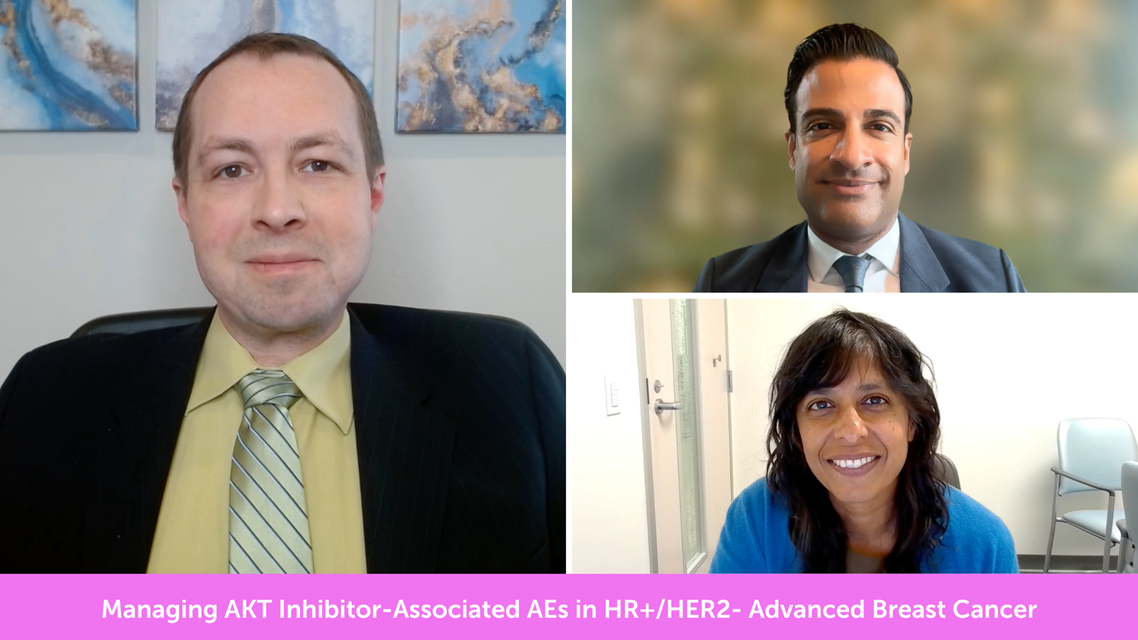
This is Project Oncology on ReachMD, and I'm Dr. Charles Turck. Joining me to discuss proactive strategies for the monitoring and managing of AKT inhibitor-associated adverse events in HR-positive, HER2-negative advanced breast cancer are Dr. Neil Iyengar and Ms. Sarah Donahue.
Dr. Iyengar is an Associate Professor of Medicine and the Co-Director of Breast Medical Oncology at the Emory Winship Cancer Institute in Atlanta, Georgia. Dr. Iyengar, welcome to the program.
Dr. Iyengar:
Thank you for having me, Dr. Turck.
Dr. Turck:
And Ms. Donahue is a breast medical oncology nurse practitioner at University of California, San Francisco Health. Ms. Donahue, thank you for being here today.
Ms. Donahue:
Thanks for having me.
Dr. Turck:
Well, let's jump right in. Starting with you, Dr. Iyengar, when you're preparing a patient for treatment with an AKT inhibitor, what does your pre-treatment workflow look like to proactively reduce the risks of rash, hyperglycemia, and diarrhea?
Dr. Iyengar:
I would note that it is important to identify patients who are candidates for AKT inhibitor therapy as early as possible—even at the time of metastatic breast cancer diagnosis. This allows us the time during first-line therapy to really optimize primarily glycemic status. Hyperglycemia, of course, is a potential adverse effect associated with AKT pathway inhibitors, and reducing risk factors prophylactically can really improve patient experience and also improve adherence as well as prevent or at least reduce the risk of dose modifications.
So if we identify those patients who are candidates for AKT inhibitor therapy early, we have all that time during first-line therapy to implement glycemic control optimization therapies, and this includes primarily lifestyle behaviors such as diet and exercise.
Also, measuring hemoglobin A1C early on will give you a sense of how much additional glycemic control is needed. This also gives you time to institute prophylactic medications like metformin and involve an endocrinologist if more advanced therapy is needed to optimize glycemic control.
Now, closer to the time of initiating AKT inhibitors, we can also be more intensive about optimizing glycemic control, and this tends to be medical management and involving that endocrinologist. We can also focus on additional prophylactic therapy, such as rash prophylaxis. I generally recommend starting a non-sedating antihistamine 24 hours before starting the AKT inhibitor; an example is cetirizine.
For diarrhea, this is mainly education. We educate our patients to keep antimotility agents like loperamide on hand as they are starting AKT inhibitor therapy so that they can use it at the first sign of diarrhea. This tends to stop diarrhea sooner rather than waiting until the diarrhea has become more severe and more difficult to control. So all of these therapies are important to institute before starting the AKT inhibitor.
Dr. Turck:
Thanks for that context, Dr. Iyengar. And with that, I'd like to dig a little bit deeper into each of these adverse events. Focusing first on rash, Ms. Donahue, what evidence-based prophylaxis strategies do you consider standard, and how do you counsel patients about early skin changes?
Ms. Donahue:
So with the AKT inhibitors, we don't have any trials showing that prophylaxis will prevent the rash. However, with the PIK3CA inhibitor alpelisib, we do know that medications like loratadine given as prophylaxis can prevent the rash. So we apply that knowledge to the use of the AKT inhibitor capivasertib. I have my patients start something like loratadine twice a day at 10 milligrams on the first day that they start the medication. And that has worked really well in preventing rash. I would rather do that than wait, because when I've waited before, I found that it's been harder to get the rash under control.
When a patient does have a rash, it usually occurs within the first two to three weeks. So I let them know that. I also let them know that they need to let me know if they're having a rash. So even if they think that they're doing all the things that they should be doing to take care of it, I need to know and see if I can add anything that would help make the rash resolve more quickly. Things like topical steroids can be really helpful, and sometimes I have them see dermatology if I feel like it's more extensive.
Dr. Turck:
And coming back to you, Dr. Iyengar, hyperglycemia is another key concern. You touched a little on this just earlier, but how do you risk stratify patients before treatment? And is there anything else you can tell us about what preventive or early antihyperglycemic strategies you put in place for those at higher risk?
Dr. Iyengar:
Certainly, identifying patients who may have poor glycemic control at baseline is important. And this can be done by measuring a hemoglobin A1C. If you know your patient has diabetes, speaking with the endocrinologist or primary care physician who's managing their diabetes is important to get a sense of what that control looks like.
Of course, the hemoglobin A1C level will give you a sense of that glycemic control. Now, we know that a hemoglobin A1C level of eight or less is necessary for using an AKT inhibitor like capivasertib. I will say that some real-world studies have identified specific risk factors even within that therapeutic range of hemoglobin A1C—towards the higher end of that A1C range—that can predict for a higher risk of developing hyperglycemia or more severe hyperglycemia. And so even if your patient has a hemoglobin A1C that is within range, trying to lower that down to normal levels—ideally less than six, although it’s not necessary to delay AKT inhibition if you can't get it down to that level—this will make for a smoother experience when using an AKT inhibitor.
The things that I like to implement to bring down that hemoglobin A1C level are, for example, a plant-forward, minimally processed, whole-food diet, which generally has a moderate-to-low level of carbohydrate intake. It doesn't necessarily need to be a low carbohydrate diet or even a ketogenic diet, but generally, on the lower end of simple carbohydrates will be helpful in terms of improving that control.
Using metformin prophylaxis can be helpful as well for patients who have diabetic range hemoglobin A1C or even pre-diabetes range hemoglobin A1C. And for those patients who do have diabetes or difficult to control blood sugar levels, involving an endocrinologist early is critical because many of these patients will end up needing polypharmacy, or multiple agents, to control their glycemic range while on therapy as well.
Dr. Turck:
For those just tuning in, you're listening to Project Oncology on ReachMD. I'm Dr. Charles Turck, and I'm speaking with Dr. Neil Iyengar and Ms. Sarah Donahue about the monitoring and managing of AKT inhibitor-associated adverse events in patients with HR-positive, HER2-negative advanced breast cancer.
So, Ms. Donahue, the last adverse event I'd like to talk to you about today is diarrhea. What prophylactic counseling and early interventions have you found most effective in minimizing its severity and the treatment disruption it can cause?
Ms. Donahue:
So diarrhea can happen with these medications, as you know. It can also happen if a patient is being put on an antihyperglycemic. So I make sure that they know either medication can cause the problem. I make sure that they have something like loperamide at home or in their bag at all times. I tell them to take it at the first sign of diarrhea because I don't want to have them play catchup or have it get out of hand where they're having more than three stools that are loose or watery in a 24-hour period. So that's my cutoff that I think is acceptable.
I also let them know that dietary changes can be helpful, like avoiding spicy foods and fatty foods. Sometimes patients will say that raw vegetables will aggravate it, so I'll have them have a more bland diet with like bread, rice, apples—the BRAT diet. That can be really helpful. If they are having diarrhea, I also, in addition to the dietary modifications, make sure they're hydrating because they're losing a lot of water.
And again, like I said, if they're having more than three loose, watery stools in a 24-hour period, they need to let me know right away. We might need to stop the medication for a short period while they recover, advise them on how to use loperamide better, or add another medication for diarrhea.
Dr. Turck:
Now, as we approach the end of our program, I have one more question for each of you. Dr. Iyengar, I'll turn to you first. Across these three adverse events, is there anything else you can tell us about how you apply grade-based management algorithms and practice, and what are the key escalation points that prompt dose interruption, reduction, or a treatment hold?
Dr. Iyengar:
Absolutely. So using grading to understand the severity of the adverse effect is really critical because this does dictate the type of management that we apply, and certainly it also provides objective parameters for understanding the severity of that adverse effect. All of this information is available in the label in the prescriber information.
However, I would also like to note that we do have additional information that can be useful to clinicians. For example, we recently published a paper of expert guidelines in npj Breast Cancer for the management of AKT inhibitor adverse effects, and these guidelines provide very user-friendly flow charts to guide you through adverse event management based on grade.
Now, the first thing that's key is identifying what baseline is for that patient. For example, in a patient who has diarrhea, understanding their baseline bowel patterns is critical to know how the medication or therapy has impacted those bowel patterns and what type of management we may need to apply. So grading oftentimes takes into consideration baseline levels.
In addition to that, for rash, we know that grading applies to body surface area in terms of involvement of the rash. And this is where the palm technique, for example, can be helpful, where the palm represents about one percent body surface area. We can educate our patients to estimate the amount of body surface area that is involved by using this surrogate of about one percent of body surface area. Certainly, taking photographs and sending them through the electronic medical record is helpful as well. And for hyperglycemia, this, of course, is objective data that we're measuring in the laboratory. So much of the grading is done on the clinician side.
All of this will really help dictate the type of management, whether it's pausing treatment, utilizing other medications to manage those adverse effects, or even a dose modification. This will all be found in the flow charts that I just mentioned from the consensus paper, which really makes it much more straightforward to be not only proactive, but also reactive to any type of adverse event that might arise.
Dr. Turck:
And finally, Ms. Donahue, let's talk about patient education. What strategies do you use to ensure patients recognize symptoms, monitor them at home appropriately, and know exactly when to contact their care team?
Ms. Donahue:
Before somebody is put on a medication like capivasertib, I make sure they know what the potential side effects are. Written information is helpful, or if they're taking notes, that's really helpful. I then go through each of the different potential, more common side effects and what to do in each instance.
We have nurses in our group who call patients who are newly on any medication in the metastatic setting, and they'll call them usually once a week to check in and see how they're doing. I think that is also helpful because there's a lot of patients who don't want to bother anyone; we all know those patients. So having somebody call and ask them how they're doing can be really helpful. And our pharmacists also will help in the beginning with giving the patient information, and they'll do regular check-ins as well.
So again, just having a whole team of people is really important. It's not just the oncologist and the nurse practitioner, but it's also your triage nurses, your pharmacist, family members, and the patient themselves altogether working to help a patient get through treatment and have the best outcomes possible.
Dr. Turck:
Those are great takeaways for us to think on as we wrap up our program. And I want to thank my guests, Dr. Neil Iyengar and Ms. Sarah Donahue, for joining me to share these strategies for the prophylaxis and early management of AKT inhibitor-related adverse events in HR-positive, HER2-negative advanced breast cancer.
Dr. Iyengar, Ms. Donahue, thank you both for joining us today.
Dr. Iyengar:
Thank you for having us.
Ms. Donahue:
Thank you for having me.
Announcer:
You’ve been listening to Project Oncology, and this episode was sponsored by AstraZeneca. To access this and other episodes in our series, visit Project Oncology on ReachMD.com, where you can Be Part of the Knowledge. Thanks for listening!