
Transcript
Dr. McDonough:
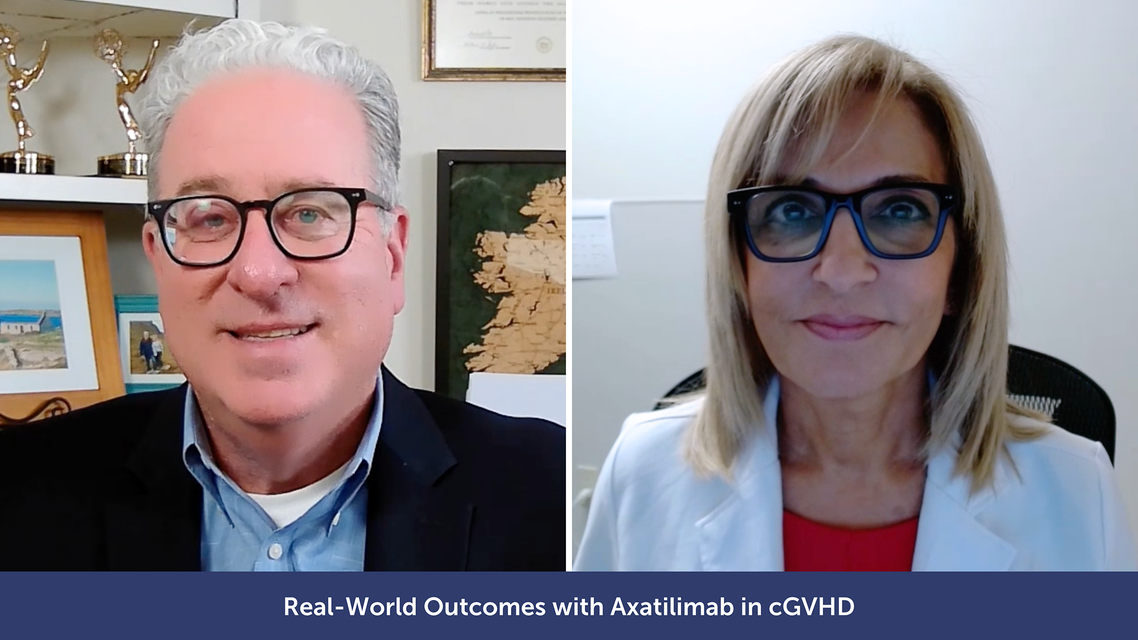
This is Project Oncology on ReachMD, and I'm Dr. Brian McDonough. Joining me today is Dr. Hana Safah, Director of Heme-Malignancy and Cell Therapy Program at Our Lady of the Lake in Baton Rouge, Louisiana. She's also a joint professor at Louisiana State University. Together, we'll be reviewing data from a recent analysis of an expanded access program that evaluated outcomes among patients with chronic graft-versus-host disease, or GVHD for short, who were treated with axatilimab. The study was presented at the 2026 Annual Meeting of the European Society for Blood and Marrow Transplantation. Dr. Safah, thanks so much for being here today.
Dr. Safah:
Thank you for having me.
Dr. McDonough:
Well, let's start with some context, Dr. Safah. This analysis evaluated the safety and clinical benefit of axatilimab in patients with chronic GVHD who had received at least two prior lines of systemic therapy. Why was it important to study this particular patient population in an expanded access program?
Dr. Safah:
The expanded access program provides some insight into treatment use in a broader real-world patient population because it used the FDA-approved dose for axatilimab that was used in the treatment of that patient population. So again, you're looking at the clinical benefit and safety in that patient population in the real-world setting. The data does complement findings from the pivotal AGAVE-201 trial, and it does help when we add the real-world data to the trial data and make sure that it mirrors it. And whenever we see that the data mirrors, as you will see soon, then it brings confidence in the results of the trial that was shared initially.
Most patients had multi-organ involvement, and for those of us who take care of chronic GVHD, whenever we see multi-organ involvement in severe disease, these are the patients with unmet needs. So regarding the multi-organ involvement, 45 percent had at least four organs involved, and almost half of those patients had lung involvement, which is a very critical organ to be involved. And two-thirds of these patients had what we call severe chronic GVHD.
Dr. McDonough:
Turning now to the findings, investigators reported clinician-assessed clinical benefit in 86.5 percent of patients. Additionally, overall response rates were 49.1 percent among patients with at least two resupplies of axatilimab, and 70.8 percent among those with at least three resupplies. So how do you interpret these efficacy findings, especially considering this was such a heavily pretreated population?
Dr. Safah:
As I mentioned earlier, this is a patient population with unmet needs. So seeing that 86.5 percent or 90 out of the 104 patients did show benefit and response—or what we call clinical benefit—is amazing. Response rate appeared to be higher among patients who remained on the treatment for a longer time—49 percent versus 70.8 percent in those patients who were receiving the drug over a longer period of time. So these findings suggest meaningful activity in the heavily pretreated patients, and the data may offer insight into the potential benefits of continued treatment in appropriate patients with chronic GVHD.
Dr. McDonough:
For those just tuning in, this is Project Oncology on ReachMD. I'm Dr. Brian McDonough, and I'm speaking with Dr. Hana Safah about the findings from a recent analysis of an expanded access program that examined clinical outcomes with axatilimab in patients with chronic graft-versus-host disease, or GVHD.
Now, Dr. Safah, the analysis also reported that some patients were able to reduce corticosteroid use over time. Six patients were even able to completely taper off steroids, and others achieved substantial dose reduction. From your vantage point, how important are steroid-sparing effects when you're evaluating a treatment for chronic GVHD?
Dr. Safah:
When we think of chronic GVHD treatment, first-line of therapy is always steroids. And we know that steroids, especially when we use high-dose steroids, can cause a lot of complications—osteoporosis, increase in blood sugar, diabetes induced by steroids, and myopathy. All of those do make patients sick and add morbidities to patients with chronic graft-versus-host disease. So in these patients, when we start treatment, number one, we're aiming for a response. Number two, which is as important as number one, is we want to, as much as possible, discontinue the use of high-dose steroids, and if not discontinued, we would like to taper as soon as possible.
So when we look at the data, we see that six patients discontinued corticosteroids entirely during the follow-up. Additional patients—around 31 of them—had achieved reductions that were greater than and/or less than 50 percent of the steroid dose, which is really important. So they not only discontinued, but a good number of those patients were able to enjoy dose reduction of the corticosteroids being used.
So reducing corticosteroid exposure remains a very important goal in chronic graft-versus-host disease management, and steroid reduction may provide additional context when assessing real-world treatment benefit with axatilimab.
Dr. McDonough:
Another notable finding was that when the expanded access program closed, 67.3 percent of patients transitioned to commercial axatilimab, and among those with at least three resupplies, that figure reached 75 percent. So what does this tell us about treatment persistence and potential clinical benefits?
Dr. Safah:
Well, 70 patients did transition to commercial therapy following the closure of the expanded access program, which means that patients were enjoying benefit from the treatment as well as tolerating the treatment. So we're talking about efficacy and tolerability. Three-quarters of the patients with at least three resupplies continued treatment commercially.
Again, this adds to our previous knowledge from AGAVE-201 that it is a well-tolerated treatment with clinical efficacy. Continuation of therapy may reflect ongoing benefit as well as tolerability, as I have mentioned. So these observations do provide an additional real-world perspective on the treatment durability, and that's something I truly discuss with my patients when I start evaluating them for a new treatment. They want to know about the efficacy of the treatment; they want to know about the tolerability, and they want to know if this is something that they're going to be able to handle as well as receive over a prolonged period of time if it's working. And I do share that data with them, and this will help me with my discussions with my patients.
Dr. McDonough:
And if we zero in on safety findings for a moment, they were consistent with what was reported in the AGAVE-201 study, as no new or unexpected toxicities were identified, and only 4.8 percent of patients discontinued treatment. What do these real-world findings add to our current understanding of axatilimab's safety profile?
Dr. Safah:
I think it's very reassuring when we look at safety data and we see that it mirrors what has been published in the past. So again, the most common treatment-related adverse events were generally consistent with the known safety profile for axatilimab that has been published in AGAVE-201.
So that's really reassuring not only to us as physicians, but also to patients because that's what you speak of when you're introducing new treatments to these, I would say, sick patients. Again, looking at the patient population that was looked at, they’re heavily pretreated, still on two or more treatments for chronic graft-versus-host disease, and more than four organ involved. These are pretty sick patients, and they are looking for something to help them with their disease, and they're looking for better outcomes.
Again, what's reassuring is that no new safety signals were identified with the expanded access program, meaning that when the drug was used with the FDA-approved dosing in the real world, no new safety signals were identified. And this assures us that in our practice, we're not going to see new toxicities that we did not see in the clinical trial.
Dr. McDonough:
Just to bring this all together before we close, Dr. Safah, can you tell us about the key lessons you took away from this expanded access program?
Dr. Safah:
So the expanded access program, again, allows us to look at the largest real-world experience with axatilimab and the FDA-approved dose in chronic graft-versus-host disease management and treatment.
Findings did demonstrate clinical benefit with a very good overall response. There was evidence of corticosteroid reduction, which I spoke of as being one of the very important goals in looking at new treatments for chronic graft-versus-host disease. And it also confirmed the safety profile that we saw in the AGAVE-201 without any new, I would say, flags or unexpected toxicities that we didn't see before. And again, that's very reassuring for our patient population.
So these results provide additional real-world evidence supporting what we have learned from AGAVE-201 with respect to the effectiveness and safety of axatilimab in the management of patients with chronic graft-versus-host disease.
Dr. McDonough:
That's a great comment for us to think on as we come to the end of today's program. And I want to thank my guest, Dr. Hana Safah, for joining me to discuss clinical outcomes among patients with chronic graft-versus-host disease who were treated with axatilimab. Dr. Safah, it was great having you on the program.
Dr. Safah:
Thank you so much.
Dr. McDonough:
For ReachMD, I'm Dr. Brian McDonough. To access this and any other episodes in our series, visit Project Oncology on ReachMD.com, where you can Be Part of the Knowledge. Thanks for listening!