
Transcript
Announcer:
You’re listening to Project Oncology on ReachMD, and this episode is sponsored by Bristol-Myers Squibb. This is a non-certified educational series produced and controlled by ReachMD. Here’s your host, Dr. Steve Jackson.
Dr. Jackson:
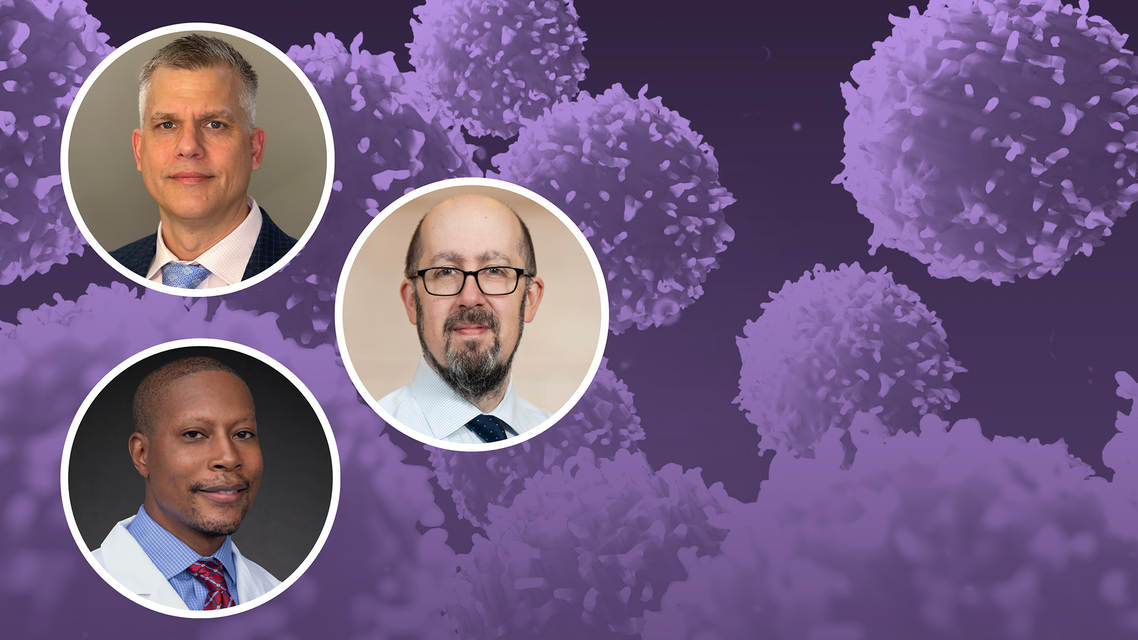
This is Project Oncology on ReachMD, and I'm Dr. Steve Jackson. Joining me today to explore how we can improve the timing and coordination of CAR T referrals for patients with relapsed and refractory large B-cell lymphoma are Drs. Matthew Matasar and Tycel Phillips.
Dr. Matasar is the Chief of Blood Disorders at Rutgers Cancer Institute and a Professor of Medicine at Rutgers Robert Wood Johnson Medical School in New Jersey.
Dr. Matasar, welcome to the program.
Dr. Matasar:
Thank you so much, Steve. We're really happy to be here today.
Dr. Jackson:
And Dr. Phillips is an Associate Professor in the Department of Hematology and Hematopoietic Cell Transplantation at City of Hope in Duarte, California.
Dr. Phillips, thank you for being here today as well.
Dr. Phillips:
Thank you.
Dr. Jackson:
So let's start with you, Dr. Matasar. When a patient with large B-cell lymphoma relapses or becomes refractory, what clinical or practical signals prompt you to consider referral for CAR T-cell therapy?
Dr. Matasar:
That's a great question, and it really reflects the fact that we've seen a sea change in how we approach patients with relapsed or refractory large cell lymphoma. Before the era of CAR T-cell therapy, I would've answered that question by saying, “Well, you have to decide if a patient is transplant eligible. And if they are, you're going to push for a transplant. You're going to try to give them platinum-based chemotherapy and do the best you can to get a CR. And if they're not, then you're going to give them palliative treatment and try to extend life the best you can.”
We're in a different era now, and the question is twofold. It's, “How long did first-line therapy hold a patient? Is this a patient with early relapsing or primary refractory disease, or is it a late relapse?” And if it's early relapsing or primary refractory, then you're just asking yourselves the question of, “Can I give this patient a CAR safely and effectively?” Yes or no. And if yes, which is the majority of patients in the modern era, then you start figuring out how to do that bridging, holding, apheresis, and all the steps that you need. But that's the question that we ask.
And even for the late-relapsing patients, if they’re transplant ineligible or maybe it's suboptimal therapy given comorbidities, even there, you're going to be asking yourself that same question: “Is this a patient who could benefit them from CAR?”
Dr. Jackson:
And turning to you now, Dr. Phillips, why is there so much variability in how clinicians approach referral, timing, and urgency, and how does that lack of alignment contribute to delays in care?
Dr. Phillips:
There’s a multitude of factors. If we could summarize it in one succinct point, we wouldn't have a lot of the issues we have now with referrals for CAR T. If we had to guesstimate, I would say maybe 20 to 25 percent of eligible patients actually make it to CAR T cell therapy.
Depending on the location of the center, you may not be in the vicinity of a referral center for CAR T-cell therapy or even stem cell transplantation, so that could factor into some of the issues. Some of it, we used to say, was just lack of awareness of CAR T-cell therapy or alternative treatment options. I think that's probably less of an issue today.
Some of it still comes down to patients. If you live outside of a major metropolitan area, there is still some reluctance for patients to come into academic or tertiary centers where they can receive cellular therapy. Some of it is lifestyle related, meaning they can't afford to take the time off, or they don't have a caregiver who can come down there with them. Some of it is, again, just reluctance to going to what they sometimes deem big cities and having to live in those areas for two to three weeks—sometimes even longer depending on the complications that may or may not come up with CAR T-cell therapy.
And then some of it's just disease related. Sometimes, you don't have time to refer a patient out; the disease itself is not going to sit and wait. So in a lot of these cases, patients have to receive other treatment options, which invariably can delay the referral down for CAR T-cell therapy or other treatment options at a tertiary center.
There’s a multitude of different issues that we have yet to fully overcome. It all narrows down to the one major point: we still have a lot of difficulties and issues getting patients to CAR T-cell therapy, who actually would likely benefit from CAR T-cell therapy.
Dr. Jackson:
And building on that, Dr. Matasar, can you walk us through some of the communication gaps that tend to occur between referring providers and CAR T centers?
Dr. Matasar:
Sure. We always would prefer for a community oncologist or a primary oncologist who's been taking care of a patient to text, pick up the phone, or reach out and say, “I have this patient. I'm not sure whether this is a CAR candidate or not, but can I tell you a story?” We want nothing more than for oncologists to be considering CAR as part of that algorithm. The majority of the time it's going to be the preferred choice; it's when oncologists don't pick up that phone. They say, “Well, this is an older patient. This is going to be too much. I don't know if this makes sense,” and they don't initiate that conversation. That, for me, is the number one greatest communication gap.
Yes, we can do a better job articulating the tremendous survival benefit that we think CAR T-cell therapy affords patients with relapsed or refractory large cell lymphoma. Yes, we could be clearer about understanding some of the logistics, the risks and benefits, and the unique toxicities of this class of agents. But the most important conversation is the one that you have to talk about the case.
Dr. Jackson:
And beyond communication, Dr. Phillips, what other logistical and system-level barriers stand in the way of timely referral?
Dr. Phillips:
Probably the biggest one, unfortunately, is insurance. Our insurance providers dictate where patients can go for CAR T-cell therapy. They dictate the approval; a lot of the things that we need to do for a CAR, we can't do without that approval.
So initially, again, if a patient says they want to go to clinic X, but the insurance dictates clinic Y, then a patient has to get in with clinic Y and have to wait to be seen. Once they're seen, there has been an initial evaluation after which there is then a referral placed. And once that referral is approved by the insurance, then you can start the procedures for CAR T-cell therapy. A lot of it is just, in some ways, checking boxes—bone marrow transplant, MRIs, CT scans, blood work, all of that—just to be sent back to the insurance before you can get in to start the apheresis process.
I will say, after the insurance process has been the biggest improvement. I think we've seen a dramatic improvement in time from apheresis to manufacturing to return of CAR T-cell therapy, even for some of the more timely ones. I would say in most patients, they can get a CAR T-cell product within three to four weeks at the longest, especially in the second line space.
Thereafter, the bigger issue, again, is the initial foot in the door. Once you can overcome that hurdle, the timeline is fairly smooth in most of these CAR T-cell centers as we've gotten quite a bit better, I would say, over the last decade of getting patients to apheresis and then manufacturing and getting the cells back, in addition to the CAR T-cell manufacturers having multiple manufacturing centers in and around the country. All that had helped speed up that part of it. So in the end, we're still just trying to overcome the insurance part, which is becoming more and more difficult as time has gone on.
Dr. Jackson:
For those just tuning in, you're listening to Project Oncology on ReachMD. I'm Dr. Steve Jackson, and I'm speaking with Drs. Matthew Matasar and Tycel Phillips about reducing delays in CAR T referral for patients with relapsed and refractory large B-cell lymphoma.
So with all these barriers in mind, Dr. Matasar, can you tell us about some practice-based models or strategies that can help streamline coordination between referring providers and treatment centers?
Dr. Matasar:
Practice-based solutions to these challenges are always going to be unique to a given practice—how that place works in the context of its health system, its referring providers, and its patient population. But most of the practice-based enhancements that we're working on right now in terms of trying to ease the barrier to CAR T-cell therapy really focus around trying to ease access. So how do we improve our ability to promptly see new patients who are being referred in, ideally within 72 hours of initial referral? That means having enough providers around and enough new visit slots that you can get a patient in quickly. Are we going to offer telemedicine visits to support that as a way to, again, ease the initiation and that first conversation with a patient to talk about this as a choice and as an option?
And then there’s everything that we need to do in terms of checking our boxes and scheduling the apheresis, but also completing whatever is required by insurance, who often create barriers to approval for apheresis and all that follows. So it’s whatever testing is required, ranging from infectious disease markers all the way to making sure that colonoscopies, mammograms, pap smears, PSAs and whatever health screening is required in order to satisfy the insurance concerns regarding giving us the authorization that we need to deliver the care that the patient.
Dr. Jackson:
Before we close, Dr. Phillips, what opportunities exist for earlier education, shared planning, and proactive communication to ensure patients are considered for CAR T at the right time?
Dr. Phillips:
Some of that starts at the initial visit with whoever the primary physician is—just having that initial conversation. For the most part, we all do an interim scan—whether that's a right or wrong situation and whether it has really any real long-term validity still up for debate. But I think at that point, if there is anything in that scan or anything along the clinical course that suggests that this patient may not have an appropriate outcome, it's never too early to start that CAR T conversation just to lay the groundwork of what's required and what may be needed from the patient, their family, or whoever their caregiver may be at that period of time. We’re continuing to address some of the concerns that come up.
And then I think most all, referral providers can have a referral center they have a relationship with. And as Matt discussed earlier, just having very succinct conversations: “Hey, this is a patient we're worried about. Just want to give you a heads up.” Or even when that first referral is placed, ideally reaching out because a lot of times, we can expedite appointments for patients once we get a heads up that they have been referred, especially for CAR T. And I think for specialized CAR T-cell centers, it's continuous evaluation and modernization of our own internal approaches to try to speed things along. A lot of us are trying to improve the environment in which patients are receiving these CAR T-cell therapies, and a lot of us are trying to shift these patients into more of an outpatient setting where, again, you're not truly going home, but at least it's a little bit better than the four walls of a hospital. It’s a little bit more freedom and a little bit more real life versus having to be confined to a hospital room for four weeks, if we can in most situations.
I think there is a still a great push to try to do whatever we can to increase accessibility to this lifesaving treatment for some. We may not ever reach 100 percent of patients who would be eligible for CAR because there are disease factors that are always going to be unpredictable. But we can hopefully eliminate some of the human barriers that are there—referral times, other issues that come up that prevent patients from getting a CAR T-cell therapy. That would be the hope—that we can get to a point where at least 80 to 85 percent of patients, hopefully more, who are eligible can receive CAR T-cell therapy, especially knowing that we have years and years of data supporting the efficacy of this regimen.
Now, there are new CAR products that are being developed that hopefully will still speed up the process even more, to this efficiency metric that Matt spoke about. Again, there are other ways we can hopefully make things a bit faster. And hopefully, as time goes on, across the healthcare spectrum, we can have better ways of having communication with insurance providers to eliminate some of these unnecessary barriers that we have in place. Even today, we have patients actually getting denied for CAR T-cell therapy, and we're having to argue and debate about the benefits of this treatment.
Dr. Jackson:
That is a great way to round out our discussion. And I want to thank my guests, Drs. Matthew Matasar and Tycel Phillips, for joining me to discuss how we can address gaps in the CAR T-cell therapy referral process for patients with relapsed and refractory large B-cell lymphoma. Dr. Matasar, Dr. Phillips, it was great having you both on the program.
Dr. Matasar:
Thanks so much, Steve.
Dr. Phillips:
Yeah, thank you.
Announcer:
You’ve been listening to Project Oncology, and this episode was sponsored by Bristol-Myers Squibb. To access this and other episodes in our series, visit Project Oncology on ReachMD.com, where you can Be Part of the Knowledge. Thanks for listening!